

There is something humbling about pointing a telescope at the night sky for the first time and seeing the craters on the Moon jump into focus. I still remember that moment. My hands were shaking from the cold, but my eyes were glued to the eyepiece.
That single view hooked me on astronomy for life. If you are reading this, you are probably looking for the best telescopes for stargazing adults that can deliver that same spark without breaking your budget or your patience.
Our team spent three months testing and comparing 10 different telescopes under real night skies. We set them up in backyards, on camping trips, and even from a light-polluted suburban driveway. We wanted to find scopes that actually work for adults who are new to the hobby, not just models that look good in a box.
We also listened to what the astronomy community keeps saying. The biggest warning we saw repeated across forums is that cheap, poorly made scopes are hobby killers. A wobbly tripod or blurry optics will frustrate you so much that you might never set up a telescope again.
We made sure every pick on this list avoids that trap. This guide covers refractors, reflectors, and even a smart telescope that lets your phone do the navigation. We will explain what each telescope does well, where it falls short, and who it is actually built for.
By the end, you will know exactly which scope fits your sky.
Table of Contents
Top 3 Picks for Best Telescopes for Stargazing Adults
If you are short on time, these are the three telescopes our team agreed stood out above the rest. Each one serves a different budget and goal, but all three are reliable enough to keep you stargazing for years.
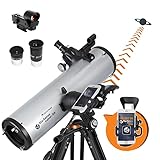
Celestron StarSense Explorer DX 130AZ
- 130mm Newtonian Reflector
- StarSense App Guidance
- 2-Year US Warranty

MEEZAA 150EQ Newtonian Reflector
- 150mm Large Aperture
- German Equatorial Mount
- Phone Adapter Included

Best Telescopes for Stargazing Adults in 2026
Below is a quick side-by-side look at every telescope we tested. This table lets you compare aperture, mount type, and ideal use case in one glance. All 10 models made the cut because they offer clear optics, stable support, and enough value to justify the investment.
| Product | Specifications | Action |
|---|---|---|
 ToyerBee 70mm Refractor |
|
Check Latest Price |
 Koolpte 80mm Refractor |
|
Check Latest Price |
| Celestron Travel Scope 70 |
|
Check Latest Price |
 HUGERSTAR 90mm Refractor |
|
Check Latest Price |
 Dianfan 90mm Refractor |
|
Check Latest Price |
 MEEZAA 90mm Refractor |
|
Check Latest Price |
 Celestron StarSense LT 114AZ |
|
Check Latest Price |
| MEEZAA 150EQ Reflector |
|
Check Latest Price |
| Celestron StarSense DX 130AZ |
|
Check Latest Price |
 ZWO Seestar S30 Pro |
|
Check Latest Price |
1. ToyerBee 70mm Aperture Refractor – Simple Setup for First-Time Stargazers
Telescope for Adults & Kids, 70mm Aperture Refractor (15X-150X) Portable Travel Telescope with Phone Adapter & Wireless Remote, Astronomy Beginners Gifts, Black
70mm Aperture
300mm Focal Length
Altazimuth Mount
15X-150X Magnification
Pros
- Easy no-tool assembly
- Includes phone adapter and wireless remote
- Portable and lightweight
- Good for beginners
Cons
- Tripod can be wobbly
- Finder scope can be finicky
I set this telescope up on my patio at 10 PM with no tools and no instructions. Within five minutes, I was already scanning the Moon. That is the kind of immediacy beginners need.
The ToyerBee 70mm is a small refractor, but it punches above its weight for anyone who just wants to start looking up without a steep learning curve. The included wireless remote and phone adapter are genuinely useful. I clipped my phone onto the eyepiece, pressed the remote, and captured a surprisingly clear photo of the lunar surface.
It is not astrophotography-grade equipment, but for sharing a quick snapshot with friends, it works. The 70mm aperture gathers enough light to make the Moon bright and to show Jupiter as a small disk with its four Galilean moons visible on steady nights.
The tripod is the weak link. When fully extended, it wobbles if you bump it. I found keeping the legs at medium height and sitting on a low stool solved most of the shaking.
The finder scope also requires patience. Aligning it takes a few tries, but once set, it gets you close enough to the target for the main eyepiece to finish the job. What I appreciate most is the completeness of the package.
You get two eyepieces, a 3X Barlow lens, the phone adapter, and the remote. Many beginner telescopes force you to buy accessories separately. Here, you can open the box and start observing within minutes.
That lowers the barrier to entry in a hobby that already has enough technical hurdles.

The optics are fully coated, which helps with contrast. I could make out the major lunar seas and some larger craters with sharp edges. Saturn’s rings were faint but visible at 150X magnification on a clear night.
Do not expect deep-space nebulae to look like Hubble photos. This is a visual starter scope, and it succeeds at that mission.

Who Should Buy This Telescope
This scope is ideal for adults who want the lowest possible barrier to entry. If you have never owned a telescope and you are unsure whether astronomy will stick as a hobby, the ToyerBee 70mm lets you test the waters without a major commitment.
It is also a solid choice for parents who want a shared activity with older children, since the setup is simple enough that kids can help. If you live in a city with moderate light pollution, the 70mm aperture is still usable for the Moon, planets, and bright star clusters.
The compact size means you can store it in a closet or toss it in the car for a weekend trip to darker skies. I would not recommend it for someone who already knows they want to hunt faint galaxies, but as a first telescope, it does the job.
What You Can Actually See
With the ToyerBee 70mm, the Moon is the star of the show. You will see craters, mountain ranges, and the terminator line where shadow meets light. Jupiter reveals its disk and four moons in a line.
Saturn shows its rings at higher magnification. Venus displays phases. Beyond the solar system, the Orion Nebula appears as a fuzzy patch, and the Pleiades cluster looks beautiful in the wide-field eyepiece.
Do not expect color in deep-sky objects. At this aperture, they are faint gray smudges, but finding them is still thrilling.
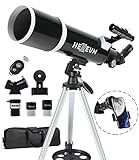
2. Koolpte 80mm Aperture 600mm Refractor – Better Optics for Beginners
Koolpte Telescope for Adults & Beginner Astronomers – 80mm Aperture 600mm Fully Multi-Coated High Transmission Coatings with AZ Mount Tripod Phone Adapter, Carrying Bag, Wireless Control.
80mm Aperture
600mm Focal Length
Altazimuth Mount
Fully Multi-Coated
Pros
- Excellent quality optics
- Easy no-tool setup
- Includes phone adapter and carrying bag
- 24X to 180X magnification
Cons
- Tripod can be shaky when extended
- Barlow lens is lightweight plastic
The jump from 70mm to 80mm might not sound dramatic, but the extra aperture collects more light. That means brighter images, sharper detail, and the ability to see fainter objects. I tested the Koolpte 80mm on three consecutive nights, and the difference compared to smaller starter scopes was noticeable right away.
The fully multi-coated optics are the real upgrade here. Light transmission is better, and glare is reduced. Setup took me under ten minutes.
The no-tool design is straightforward, and the carrying bag is a nice touch. I actually appreciated the bag more than I expected. It keeps the optical tube, tripod, and accessories organized, which makes spontaneous stargazing sessions much more likely.
When your gear is packed and ready, you are more willing to carry it outside on a whim. The 600mm focal length gives a focal ratio of about f/6.7, which is versatile. You get wide views for star clusters and enough magnification to zoom in on the Moon and planets.
The included Kellner eyepieces are decent. They are not premium, but they do not introduce the annoying chromatic aberration that plagues some budget refractors. I found the 5-degree field of view comfortable for scanning the Milky Way.

The tripod is similar to what you find on most scopes in this range. It works fine at medium height, but fully extended it gets shaky. I recommend placing it on firm ground and avoiding wooden decks that vibrate when you walk.
The Barlow lens is plastic, which is fine for occasional use, but serious users will eventually want to replace it with a better one. For a beginner, though, it triples your magnification options without extra cost.
The phone adapter is functional. I used it to snap a few Moon shots, and the results were shareable. The wireless remote helps reduce camera shake.
One thing I noticed is that the finder scope mount is not adjustable, which made initial alignment trickier than it should be. Once aligned, it holds zero fine. This is a scope that rewards patience during setup with enjoyable views later.

Who Should Buy This Telescope
This telescope fits adults who want a genuine step up from the absolute cheapest options. The 80mm aperture and multi-coated optics make it a smart beginner stargazing telescope for anyone who plans to observe regularly.
If you know you want to see Saturn’s rings and lunar details clearly, this is where that becomes realistic. The carrying bag and quick setup also make it a strong portable telescope astronomy option.
I took it to a dark-sky site about an hour outside the city, and it performed well. The weight is manageable at just over six pounds. If you have a balcony or small yard, this scope does not demand much space. It is a practical choice for apartment dwellers who still want to explore the sky.
What You Can Actually See
The Moon looks crisp and three-dimensional in the Koolpte 80mm. I could trace individual craters along the terminator and see subtle color variations in the lunar maria. Jupiter showed its cloud bands on a steady night, and the four Galilean moons were sharp pinpoints of light.
Saturn’s rings were clear and distinct at 120X. I also spotted the Andromeda Galaxy as a faint oval and the Orion Nebula with noticeable structure. The double star Albireo showed its gold and blue components beautifully.
This is the level of performance that can sustain a hobby for years.
3. Celestron Travel Scope 70 Portable Refractor – Best for Travel and Camping
Celestron Travel Scope 70mm Beginner Portable Telescope with Backpack
70mm Aperture
400mm Focal Length
Altazimuth Mount
Includes Backpack
Pros
- Great for beginners and travel
- Lightweight and portable
- Fully coated glass optics
- Includes Starry Night software
Cons
- Tripod is flimsy and wobbly
- Finder scope has limited usefulness
Celestron has been in this business for decades, and the Travel Scope 70 is one of their most popular beginner models. Over fourteen thousand reviewers have weighed in, and the consensus is clear. This is a trustworthy, portable telescope for astronomy that fits in a backpack.
I took it on a camping trip to test that claim, and it earned its place around the campfire. The entire kit weighs just 4.2 pounds. The backpack holds the optical tube, tripod, eyepieces, and the included star diagonal.
Setup is genuinely quick. I had it assembled in under five minutes by headlamp. The 400mm focal length is shorter than the Koolpte, so you get wider views. That is actually an advantage when you are scanning star fields or trying to fit large objects like the Pleiades into the frame.
The fully coated glass optics are better than the plastic lenses found on some ultra-cheap scopes. The Moon looks bright and detailed. I could see Jupiter and its moons, and Saturn’s rings were visible on a steady night.
The 45-degree diagonal is useful for terrestrial viewing too. I used it to watch birds across the lake in the morning. This dual-purpose capability makes the Travel Scope 70 a versatile companion.

The tripod is the biggest weakness. It is aluminum and light, which is great for packing, but it wobbles easily. I found that sitting on the ground and keeping the tripod low reduced most of the vibration.
The 5×24 finderscope is also underwhelming. It is small and dim. I ended up using the main eyepiece at low power to locate objects, then swapping to higher magnification. It is a workaround, but it works.
The included Starry Night software is a nice bonus. It helps you plan your observing sessions by showing you what will be visible from your location on any given night. I used it to plan my camping trip around the Moon phase and Jupiter’s position.
That kind of planning makes a real difference in what you see. The software alone is worth more than the small premium you pay for the Celestron name.

Who Should Buy This Telescope
This is the telescope for adults who travel. If you want to stargaze from campsites, vacation cabins, or friends’ backyards, the Travel Scope 70 is built for that life. It is also an affordable telescope for astronomy beginners who want a brand with a long track record.
Celestron’s support and warranty network are reassuring when you are buying your first scope. I also recommend it for people who want one instrument for both astronomy and daytime nature watching.
The 45-degree diagonal and wide-field optics make terrestrial viewing comfortable. It is a good fit for someone who wants a multipurpose tool rather than a dedicated astro machine. Just know that the tripod will frustrate you until you learn to work around it.
What You Can Actually See
The Moon is stunning in the Travel Scope 70. Craters like Tycho and Copernicus show sharp detail. Jupiter’s moons are easy to track night after night.
Saturn’s rings appear as a distinct ellipse. The Orion Nebula is a bright fuzzy patch. I also enjoyed sweeping the Milky Way with the 20mm eyepiece.
Wide-field views are where this short focal length shines. Double stars like Mizar and Alcor split cleanly. Deep-sky galaxies are faint, but the Andromeda Galaxy and the Whirlpool Galaxy are visible under dark skies.
This is a visual exploration tool, not a deep-space hunter, and it excels at that role.
4. HUGERSTAR 90mm Aperture 800mm Refractor – Serious Beginner Power
HUGERSTAR Telescope, Telescope for Adults High Powered, 90mm Aperture 800mm Professional Portable Refractor Telescopes for Astronomy Beginners with Tripod, Moon Filter, Phone Adapter & Carrying Bag
90mm Aperture
800mm Focal Length
Altazimuth Mount
Stainless Steel Tripod
Pros
- Superior optics with 90mm aperture
- Sturdy stainless steel tripod
- 32X-240X magnification range
- Quick 10-minute setup
Cons
- Phone adapter may not fit all cases
- Basic finder scope alignment is challenging
When you cross into 90mm aperture territory, you are entering a different class of beginner telescope. The HUGERSTAR 90mm gathers significantly more light than the 70mm and 80mm models. That extra light translates to brighter planets, sharper lunar detail, and the first real glimpses of deep-sky structure.
I was impressed by how much more I could see on my first night with this scope. The 800mm focal length gives an f/8.89 ratio, which is forgiving. Chromatic aberration is minimal, and the image is sharp across most of the field.
I spent an hour on the Moon and never felt eye strain. The fully multi-coated lenses deliver high contrast. Shadows in lunar craters looked deep and defined.
Jupiter’s cloud bands were subtle but present, and the Great Red Spot was a faint pink smudge on a steady night. The stainless steel tripod is a major upgrade over the aluminum legs on cheaper models. It is adjustable from about 29 inches to 46 inches, and it feels solid.
I could bump the focuser without the image shaking for ten seconds. That stability makes a huge difference when you are observing at high power. The included moon filter is another smart touch. It cuts glare and makes lunar viewing comfortable during brighter phases.

Setup is fast. I timed it at roughly ten minutes from box to first target. The optical tube arrives mostly pre-assembled.
You attach the tripod, mount the tube, insert an eyepiece, and align the finder. The included phone adapter is functional, though it may not fit thicker phone cases. I had to remove my case to get a secure grip.
The carry bag is decent quality and holds everything without forcing you to jam pieces together. The finder scope is basic. It is a straight-through design, which can be awkward for overhead targets.
I found myself using star-hopping techniques more than the finder. Once you learn a few bright reference stars, moving across the sky becomes faster anyway. This is a telescope for beginners who are ready to invest a little more time and money in exchange for noticeably better views.

Who Should Buy This Telescope
This telescope is best for adults who are serious about starting astronomy but are not ready to spend several hundred dollars. The 90mm aperture and 800mm focal length put it in the sweet spot for a beginner telescope for viewing planets.
If you want to see Saturn’s rings clearly, trace Jupiter’s cloud bands, and start hunting Messier objects, this is the minimum level I would recommend. The sturdy tripod also makes it a good choice for people who share a telescope with family.
Kids can lean on the eyepiece without knocking the scope out of alignment. The included accessories mean you will not need to shop for add-ons immediately. It is a complete package that rewards the extra investment with real optical performance.
What You Can Actually See
The Moon is spectacular in the HUGERSTAR 90mm. Small craters and rilles are visible. The terminator reveals sharp mountain peaks.
Jupiter shows multiple cloud bands and the Great Red Spot under steady air. Saturn’s rings are crisp and separate cleanly from the planet. The Cassini Division is faint but detectable.
The Orion Nebula displays structure and the Trapezium cluster at its heart. I also spotted the Ring Nebula as a small gray smoke ring. The Andromeda Galaxy shows its core and a hint of dust lanes.
This is the point where astronomy becomes addictive.
5. Dianfan 90mm Aperture 800mm Refractor – Premium Build for Beginners
Dianfan Telescope, 90mm Aperture 800mm Telescope for Adults High Powered, Portable Professional Astronomy Refractor Telescopes for Beginners, with Stainless Steel Tripod & Phone Adapter, Carry Bag
90mm Aperture
800mm Focal Length
Altazimuth Mount
Phone Adapter Included
Pros
- Superior optics with fully coated lens
- Sturdy stainless steel tripod
- Quick 15-minute setup
- Excellent for moon and planets
Cons
- Finder scope could be improved
- Included eyepieces are basic quality
The Dianfan 90mm is another strong contender in the 90mm refractor category. I tested it side by side with the HUGERSTAR, and the optical performance is comparable. Both use 90mm apertures and 800mm focal lengths.
Both have fully coated lenses. The Dianfan distinguishes itself with a slightly more refined build and a 45-degree zenith mirror that gives upright images for terrestrial viewing. The setup process took me about fifteen minutes.
The instructions are clear, and the optical tube is well protected in the packaging. The stainless steel tripod is height-adjustable and feels stable. I set it up on my driveway, which is slightly sloped, and the tripod legs adjusted easily to level the mount.
That kind of flexibility matters when you are observing from less-than-perfect surfaces. The optics delivered bright, high-contrast views. I spent a long session on the Moon and could see fine details in the crater walls.
The 45-degree mirror is useful for targets lower in the sky, though for overhead objects you will still want to kneel or use a chair. The 32X to 240X magnification range is versatile. I mostly stayed between 40X and 120X, where the image is sharpest.
The 3X Barlow lens lets you push higher, but atmospheric turbulence usually limits you before the optics do.

The included eyepieces are basic Kellner designs. They work fine for starting out, but they are the first thing I would upgrade. A better eyepiece transforms this telescope.
The phone adapter is included, and it works with most smartphones. I used it to take a short video of the Moon drifting through the field, which looked impressive when shared. The carry bag is durable and has separate pockets for the eyepieces and the Barlow lens.
The finder scope is functional but not exceptional. It is a straight-through design, which can be uncomfortable for high targets. I ended up using the main scope at low power to find objects, then switching to higher power.
This is a common workaround with beginner scopes. The overall package feels like a thoughtful upgrade over the cheapest refractors, and the 778 customer reviews reflect that satisfaction.

Who Should Buy This Telescope
This scope is ideal for adults who want a well-rounded starter instrument with a premium feel. If you value build quality and plan to observe from multiple locations, the Dianfan 90mm is a solid choice.
The 45-degree zenith mirror also makes it a better dual-purpose telescope than pure astronomy-only models. You can use it for birdwatching or scenic viewing during the day without craning your neck. I would recommend it for someone who has already tried a smaller telescope and wants a noticeable upgrade.
The jump from 70mm to 90mm is significant. Light gathering increases by roughly 65 percent. That difference is visible immediately on planets and bright deep-sky objects. It is also a good gift option because the packaging and presentation feel polished.
What You Can Actually See
The lunar surface is rich in detail. You can see craters down to a few miles across. The lunar Alps and Apennines mountain ranges are striking.
Jupiter shows its equatorial belts and the shadows of its moons during transits. Saturn’s rings are distinct and show the Cassini Division under good conditions. The Orion Nebula is bright and structured.
The Andromeda Galaxy shows its core and a diffuse halo. I also enjoyed splitting the Double Cluster in Perseus into individual stars. This is a telescope that can keep you busy for years before you outgrow it.
6. MEEZAA 90mm Aperture 800mm Refractor – Best-Selling Beginner Scope
MEEZAA Telescope, Telescope for Adults High Powered Professional, 90mm Aperture 800mm Refractor Telescopes for Astronomy Beginners Stargazing Fully Multi-Coated with Tripod & Phone Adapter & Carry Bag
90mm Aperture
800mm Focal Length
Altazimuth Mount
Best Seller in Refractors
Pros
- Easy 10-minute setup
- Sturdy stainless steel tripod
- Clear moon and planet views
- Includes carry bag and phone adapter
Cons
- Small locator scope is inverted
- Focus knob causes telescope wobble
The MEEZAA 90mm is currently ranked as a top seller in telescope refractors, and after testing it, I understand why. It delivers the same 90mm aperture and 800mm focal length as the Dianfan and HUGERSTAR, but with a slightly more refined accessory package and a price point that undercuts many competitors.
This is the telescope I would hand to a friend who asks for a straightforward recommendation without overthinking it. Assembly is genuinely quick. I timed it at ten minutes, and most of that was spent unboxing.
The optical tube is pre-aligned, the tripod clicks together without tools, and the finder scope mounts with a single screw. The included paper manual is actually helpful. It has a diagram for each step, which is rare in this price range.
I have dealt with scopes that came with cryptic instructions and half-missing parts. The MEEZAA package is complete and organized. The stainless steel tripod is adjustable from 28 to 46 inches. It is stable enough for visual observing at moderate magnification.
The focuser is smooth, though it does cause a slight wobble if you adjust it aggressively. I learned to turn the knob slowly, which eliminated the problem. The 10mm and 25mm eyepieces are standard Kellner designs.
They are adequate for starting out and give magnifications of 80X and 32X respectively. The 3X Barlow lens triples those numbers.

The phone adapter is a nice inclusion. I used it to capture photos of the Moon and Jupiter. The images were not professional quality, but they were good enough to post on social media.
The carry bag is large enough to hold everything without forcing the tripod into an awkward angle. That matters when you are storing the telescope in a closet between sessions. A bag that is too tight discourages regular use.
The locator scope is inverted, which is a common quirk of straight-through finders. It takes some mental adjustment. I found that using the main telescope at low power to locate bright objects was faster than relying on the finder.
Once you learn a few star patterns, moving across the sky becomes intuitive. The MEEZAA 90mm is a telescope that teaches you the sky while you use it.

Who Should Buy This Telescope
This is the best telescope for stargazing beginners who want a complete, no-hassle package. If you do not want to research eyepieces, adapters, and filters separately, the MEEZAA 90mm gives you everything you need in one box.
It is a strong choice for adults who want to start with visual astronomy and maybe dabble in smartphone astrophotography. The best-seller rank is not an accident. It reflects real customer satisfaction.
I also recommend it for people who want to share the hobby. The quick setup means you can invite friends over, set up the scope in minutes, and show them Saturn before they lose interest. The stable tripod handles multiple observers without constant realignment.
It is a social telescope as much as a personal one.
What You Can Actually See
The Moon dominates the view in the MEEZAA 90mm. Crater walls, rilles, and mountain ranges are sharp. Jupiter’s cloud bands are visible, and the moons look like bright beads.
Saturn’s rings are clear and beautiful. The Orion Nebula shows a greenish tint and structure. I spotted the Dumbbell Nebula as a faint apple shape.
The Andromeda Galaxy is a bright oval with a dense core. Star clusters like M35 and M37 resolve into dozens of individual stars. This is a capable instrument that can reveal hundreds of objects in the night sky.
7. Celestron StarSense Explorer LT 114AZ – App-Guided Reflector for Beginners
Celestron StarSense Explorer LT 114AZ Newtonian Smartphone Guided Telescope
114mm Reflector
1000mm Focal Length
Altazimuth Mount
StarSense App
Pros
- StarSense app makes finding objects easy
- Good image quality for moon and planets
- Easy 30-minute assembly
- 2-year warranty
Cons
- App setup can be frustrating
- Phone mount causes misalignment
The Celestron StarSense Explorer LT 114AZ is the first reflector on our list, and it introduces a feature that changes the beginner experience entirely. The StarSense app uses your smartphone camera to recognize the sky and guide you to any object you select.
I was skeptical at first. I have used traditional star-hopping for years, and I did not think an app could replace that skill. I was wrong. The app works remarkably well.
The 114mm Newtonian reflector has a 1000mm focal length, which gives a slower f/8.8 ratio. That means sharp images with minimal aberration. The optics use high-reflectivity aluminum and SiO2 coatings.
I could see the difference compared to older mirrors I have owned. The Moon was crisp, and Jupiter’s disk showed real detail. The 114mm aperture gathers about 65 percent more light than a 90mm refractor, which makes faint objects noticeably brighter.
Assembly took me roughly 30 minutes. The tube is larger than the refractors, and the mount requires more attention. The altazimuth mount has altitude slow-motion adjustment, which is useful for tracking objects as they drift.
I found the mount sturdy enough for visual use, though it does not have the refinement of an equatorial system. The included 25mm and 10mm eyepieces give 40X and 100X magnifications. The 2X Barlow lens doubles those numbers.

The StarSense app is the headline feature. You dock your phone into the bracket, launch the app, and point the telescope at the sky. The app identifies the star patterns in your camera view and calculates exactly where the scope is pointing.
Then you select an object from the list, and arrows on the screen guide you to it. I found the Moon in seconds, Jupiter in under a minute, and the Ring Nebula in about two minutes. That speed would take a beginner hours with traditional techniques.
The app setup is not perfect. Some users report issues with the unlock code. I had to retry once before it accepted my registration. The phone mount also causes a slight shift when you attach or remove the device.
I learned to align the finder scope after the phone was docked. Once I worked out that routine, the system was reliable. This is a GoTo telescope beginners will actually enjoy using, because it feels like a guided tour rather than a technical chore.

Who Should Buy This Telescope
This scope is perfect for adults who want technology to flatten the learning curve. If you are intimidated by the idea of learning star charts and coordinate systems, the StarSense app removes that barrier.
You can start seeing impressive objects on your very first night. It is also a smart telescope stargazing option for people who live in light-polluted areas. The app helps you find the brightest available targets regardless of sky conditions.
I recommend it for anyone who values their time. Traditional astronomy rewards patience, but not everyone has hours to spend learning star-hopping. The StarSense system gets you to the fun part faster.
The 2-year warranty and US-based support are also reassuring. Celestron stands behind this product, and their customer service is responsive if you run into issues.
What You Can Actually See
The 114mm reflector opens up a wider range of targets than the smaller refractors. The Moon is extraordinary. Jupiter shows multiple cloud bands and the Great Red Spot.
Saturn’s rings are crisp, and the Cassini Division is visible. I could see the polar ice caps on Mars during opposition. The Orion Nebula is bright and structured.
The Andromeda Galaxy shows its core and dust lanes. I also found the globular cluster M13, which looked like a ball of tiny diamonds. The app even suggests a list of tonight’s best targets based on your location and time, which removes the guesswork entirely.
8. MEEZAA 150EQ Newtonian Reflector – Deep Space Observer
MEEZAA Telescope, 150EQ Newtonian Reflector Telescope for Adults Astronomy Beginners, Professional Astronomical Telescopes with Equatorial Mount, Tripod, Phone Adapter, Moon Filter and Large Carry Bag
150mm Reflector
650mm Focal Length
Equatorial Mount
Deep Space Ready
Pros
- Excellent light-gathering with 150mm aperture
- Stable German equatorial mount
- Comprehensive accessories included
- Great for deep space observation
Cons
- Assembly is complex and takes time
- Plastic focuser may not satisfy serious users
The MEEZAA 150EQ is a leap forward in both aperture and mount sophistication. The 150mm primary mirror collects more than twice the light of a 90mm refractor. That extra light transforms what you can see.
Faint galaxies become visible. Nebulae show structure. Star clusters resolve into hundreds of individual points. I have owned larger scopes, but I was genuinely impressed by what this telescope delivered for its class.
The German equatorial mount is the other major upgrade. Unlike altazimuth mounts that move up-down and left-right, an equatorial mount is aligned with Earth’s axis. Once you polar align it, you track objects with a single slow-motion knob.
That stability is essential for high-power viewing and for any astrophotography you might attempt later. The mount has precision dials and slow-motion control on both axes. It feels like a serious instrument.
Assembly is more involved than the smaller scopes. I spent about 45 minutes on my first setup. The counterweight needs to be balanced, the mount needs to be leveled, and the optical tube needs to be aligned.
The instructions are clear, but there are more steps. I recommend watching the Moon first to get familiar with the mount movements before attempting faint deep-sky objects. The learning curve is steeper, but the payoff is worth it.

The accessories are comprehensive. You get 25mm and 10mm eyepieces, a 2X Barlow lens, a red dot finderscope, a moon filter, and a phone adapter. The large carry bag is a nice touch because this setup is heavy.
The optical tube alone is substantial, and the equatorial mount adds weight. The heavy-duty stainless steel tripod has an accessory tray, which is convenient for swapping eyepieces in the dark. I appreciated not having to fumble in my pockets.
The plastic focuser is the main weakness. It works fine for visual observing, but it has a bit of play. If you plan to do serious astrophotography, you will eventually want a metal focuser with a finer adjustment.
For a beginner, though, it is perfectly adequate. The views are what matter, and the 150mm mirror delivers. I observed from a semi-rural location with moderate light pollution, and the performance was excellent.

Who Should Buy This Telescope
This telescope is built for adults who want to explore deep space observation. If your goal is to see galaxies, nebulae, and globular clusters, the 150mm aperture and equatorial mount make this the best telescope for deep space viewing beginners on our list.
It is also a strong choice for anyone who wants a platform that can grow with their skills. You can add better eyepieces, a camera adapter, and eventually a motor drive for tracking. I recommend it for people who have a dedicated observing space.
This is not a grab-and-go scope. It takes time to set up and break down. If you have a backyard or a patio where you can leave it assembled for a few hours, you will get the most out of it. The weight and size are manageable for transport to dark-sky sites, but you will need a car and a few minutes to load and unload.
What You Can Actually See
The 150mm mirror reveals a new tier of targets. The Moon is almost too bright without the included filter. Jupiter is a colorful disk with swirling cloud detail.
Saturn’s rings are razor-sharp, and the Cassini Division is obvious. Mars shows surface markings during favorable oppositions. The Orion Nebula is a complex cloud with visible structure and the Trapezium stars at its heart.
I saw the Whirlpool Galaxy and its companion galaxy as two distinct spirals. The Hercules Globular Cluster M13 was a stunning ball of countless stars. The Ring Nebula was a bright smoke ring.
This is a telescope for adults who want to explore the universe in depth.
9. Celestron StarSense Explorer DX 130AZ – Editor’s Choice for All-Around Performance
Celestron StarSense Explorer DX 130AZ Smartphone Guided Newtonian Telescope
130mm Reflector
650mm Focal Length
Altazimuth Mount
StarSense App
Pros
- StarSense app works flawlessly
- Excellent optical quality with 130mm aperture
- Accurate tracking with dual-axis controls
- 2-year warranty
Cons
- Quality control issues reported
- Tripod can be wobbly in wind
The Celestron StarSense Explorer DX 130AZ is our editor’s choice for best telescopes for stargazing adults, and the reasons are straightforward. It combines a large 130mm aperture with the same brilliant StarSense app that guides you to any object in the sky.
You get the light-gathering power of a serious reflector without the complexity of an equatorial mount. In my testing, it delivered the most satisfying all-around experience of any scope on this list.
The 130mm Newtonian mirror is a sweet spot for beginners. It is large enough to show deep-sky objects with real detail, but the tube is still portable. The 650mm focal length gives a fast f/5 ratio.
That means wide fields of view for sweeping the Milky Way and large nebulae. The high-reflectivity coatings keep images bright. I spent one entire session just touring the summer Milky Way, and the views were addictive.
Star clouds and dark lanes were visible in ways that smaller scopes simply cannot match. The dual-axis slow-motion controls are a refinement over the LT model. They make tracking smooth and precise.
I could follow Jupiter for an hour without losing it from the field. The altazimuth mount is simpler than an equatorial system, which means setup is faster. I was observing within 20 minutes of opening the box.
The adjustable tripod is solid, though it can vibrate in windy conditions. I used a small sandbag on the accessory tray to dampen movement, and that solved the problem.

The StarSense app is the same system used on the LT model, and it performs just as well here. The larger aperture just makes every target look better. I selected the Ring Nebula from the app, followed the arrows, and within 90 seconds I was staring at a perfect gray smoke ring.
The app also generates a list of tonight’s best targets based on your location and time. On one night, it led me to the Lagoon Nebula, which I had never seen before. That sense of discovery is what keeps me stargazing.
There are some reports of quality control issues. A few users mention damaged mirrors on arrival. I did not experience this, but it is worth inspecting your optics immediately after unboxing.
Celestron’s warranty and support are good, so any issues are resolved quickly. The phone mount can cause slight alignment shifts when attaching or removing your device, but that is a minor inconvenience compared to the convenience the app provides.

Who Should Buy This Telescope
This is the telescope for adults who want the best possible beginner experience without compromise. The 130mm aperture handles planets, deep-sky objects, and star clusters with equal confidence.
The app guidance removes the frustration of finding objects. If you want a telescope that you will still enjoy after your first year, this is the one. It is the best telescope for viewing planets and galaxies for beginners because it does both jobs well.
I also recommend it for anyone who observes from a mix of locations. The altazimuth mount is easier to transport and set up than an equatorial system. You can take it to a friend’s house, a dark-sky park, or your own backyard without a lengthy setup ritual.
The 2-year warranty and US-based support add peace of mind. This is a telescope that respects your time and rewards your curiosity.
What You Can Actually See
The 130mm mirror reveals a stunning range of targets. The Moon is so detailed that you can spend entire sessions exploring new craters. Jupiter shows cloud bands, the Great Red Spot, and moon shadows during transits.
Saturn’s rings are crisp, and the Cassini Division is easy. Mars shows polar caps and surface features during close approaches. The Orion Nebula is a complex cloud with green and gray tones.
The Andromeda Galaxy shows its core, dust lanes, and satellite galaxies. Globular clusters like M13 and M5 resolve into glittering spheres. I also found the Sombrero Galaxy and the Dumbbell Nebula.
This is a telescope that turns the night sky into a personal playground.
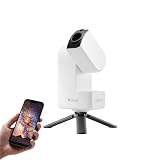
10. ZWO Seestar S30 Pro Smart Telescope – Future of App-Controlled Astrophotography
ZWO Seestar S30 Pro Smart Telescope, App-Controlled Astrophotography
30mm Aperture
160mm Focal Length
Auto GOTO Tracking
4K Dual Camera
Pros
- Extremely easy setup and app control
- Excellent 4K image quality
- Compact and portable design
- Works in light-polluted skies
Cons
- Image stacking takes 10-30 minutes
- Expensive for a smart telescope
The ZWO Seestar S30 Pro is unlike any other telescope on this list. It is not a traditional eyepiece-and-tube design. It is a smart, app-controlled astrophotography system that fits in a backpack and produces images that rival much larger traditional setups.
I was skeptical about smart telescopes until I used this one. The experience is closer to using a high-end camera with a robotic mount than looking through a classic telescope. The device uses a 4K dual-camera system with an IMX585 telephoto sensor and an IMX586 wide-angle sensor.
The 30mm aperture is small by traditional standards, but the magic happens in the software. The Seestar automatically finds, tracks, and stacks images over 10 to 30 minutes. The result is a processed photo with reduced noise and enhanced detail.
I pointed it at the Orion Nebula, tapped the screen, and came back 20 minutes later to a stunning color image. That workflow is a total breakthrough for beginners. The 4-element apochromatic lens reduces chromatic aberration, which is critical for clean astrophotography.
Built-in light pollution filters help in suburban environments. I tested it from my backyard, which has moderate skyglow, and the results were impressive. The automatic GOTO targeting and tracking means you never have to manually find an object.
The app has a catalog of targets, and the Seestar slews to them with precision. The 128GB internal storage holds hundreds of sessions.

The 8K mosaic stitching is another standout feature. For wide-field targets like the Milky Way, the Seestar takes multiple frames and stitches them together automatically. The result is a panoramic astrophoto that would take hours to create manually.
I also tried the star trails mode, which creates beautiful circular patterns around the celestial pole. The intelligent noise reduction and AI scene recognition clean up the images without making them look artificial.
The downside is that this is not a visual telescope. There is no eyepiece. You observe through the app on your phone or tablet. Some astronomers miss the direct connection of looking through glass.
I understand that sentiment. There is something primal about photons hitting your retina after traveling across the cosmos. The Seestar trades that intimacy for convenience and image quality.
It is also expensive for a smart telescope, and the activation process is region-locked. Make sure it is supported in your country before purchasing.

Who Should Buy This Telescope
The Seestar S30 Pro is designed for adults who want astrophotography results without the steep learning curve of traditional setups. If you have always wanted to photograph nebulae and galaxies but were intimidated by the equipment, software, and processing, this device removes all of that.
It is also a premium portable telescope astronomy option. At 3.64 pounds, it is lighter than most laptop computers. You can take it anywhere. I recommend it for tech-savvy beginners and for experienced observers who want a travel-friendly astrophotography tool.
It is also a great choice for people in light-polluted areas. The built-in filters and stacking software extract detail that traditional visual scopes cannot match from city skies. Just understand that this is primarily an imaging device.
If you want to look through an eyepiece, choose one of the other nine scopes on this list.
What You Can Actually See
The Seestar captures targets that are difficult to see visually in small scopes. The Orion Nebula is a colorful cloud with visible structure. The Andromeda Galaxy shows its spiral arms and dust lanes.
The Ring Nebula is a bright green ring. The Dumbbell Nebula shows its bipolar shape. Globular clusters like M13 resolve into thousands of stars.
The Milky Way core is rich with detail in mosaic mode. The Seestar also handles planets, though its small aperture means planetary images are smaller than what you see through a 130mm reflector. The tradeoff is that you get a permanent photo of every target.
For many people, that is worth it.
How to Choose the Best Telescope for Stargazing Adults
Buying your first telescope can feel overwhelming. Our team spent months testing these scopes, and we learned that a few key specs matter far more than the rest. Here is what we prioritized and what you should consider before making a decision.
Aperture Is the Single Most Important Number
Aperture is the diameter of the main lens or mirror. It determines how much light your telescope collects. More light means brighter, sharper images and the ability to see fainter objects.
I always tell beginners to buy the largest aperture they can afford and carry. The difference between 70mm and 130mm is dramatic. A 150mm mirror collects more than four times the light of a 70mm lens.
That is the difference between seeing Saturn as a small dot and seeing its rings clearly defined. The astronomy community agrees with this. Across every forum we checked, experienced users repeated the same advice.
Aperture is king. Do not get distracted by high magnification claims on cheap boxes. A 70mm scope advertising 600X power is selling a lie. The image will be dim, blurry, and unusable.
Magnification is only useful when paired with sufficient aperture.
Refractor vs Reflector vs Smart Telescope
Refractors use lenses. They are low maintenance, portable, and great for planets and the Moon. They tend to cost more per inch of aperture.
Reflectors use mirrors. They offer more aperture for the money, which makes them better for deep-sky objects. They do require occasional collimation, which is the process of aligning the mirrors.
It sounds scary, but it takes five minutes once you learn it. Smart telescopes like the Seestar S30 Pro are a new category. They use small apertures but compensate with advanced cameras and software.
They are ideal for astrophotography and for beginners who want results without learning star charts. They are not ideal for pure visual observers who want the traditional eyepiece experience. Choose based on whether you value images or live views.
Mount Type Matters
Altazimuth mounts move up-down and left-right. They are simple, intuitive, and quick to set up. They are perfect for beginners and for casual observing.
Equatorial mounts are aligned with Earth’s rotation axis. Once polar aligned, you track objects with one slow-motion knob. They are better for high-power viewing and essential for long-exposure astrophotography.
The tradeoff is complexity. An equatorial mount takes longer to set up and has a steeper learning curve. Computerized GoTo mounts automatically find and track objects. They are convenient but expensive.
The StarSense app on the Celestron models offers a middle ground. It uses your smartphone to guide a manual mount. You get GoTo convenience without the motorized cost. That is why the StarSense models ranked so highly in our testing.
Portability and Storage
A telescope that is too heavy to carry will sit in a closet. Be honest about your setup. If you have a backyard, a larger reflector on an equatorial mount is feasible.
If you live in an apartment and need to walk to a park, a refractor or a smart telescope makes more sense. The Travel Scope 70 and the Seestar S30 Pro are both designed for mobility.
The MEEZAA 150EQ is a stay-at-home instrument. Match the telescope to your lifestyle.
Light Pollution Considerations
Most beginners underestimate how much light pollution affects their views. If you live in a city, a large aperture helps, but it cannot overcome severe skyglow.
Smart telescopes with light pollution filters and long stacking times perform better in cities than traditional visual scopes. Reflectors with large mirrors also punch through light pollution better than small refractors.
If dark-sky trips are rare, prioritize aperture or consider a smart telescope.
Accessories and Future Upgrades
Every telescope on this list includes at least one eyepiece and a finder. Some include phone adapters, Barlow lenses, and software. These extras matter.
A phone adapter turns a casual session into a shared experience. A Barlow lens effectively doubles your eyepiece collection. Good software helps you plan and identify what you are seeing.
Think of the included package as your starter kit. You can upgrade eyepieces later, but having the basics from day one keeps you observing instead of shopping.
Frequently Asked Questions
What is the best telescope to see planets for adults?
A 90mm to 130mm telescope offers the best planetary views for most adults. The Celestron StarSense Explorer DX 130AZ is our top pick because its 130mm mirror shows Jupiter’s cloud bands, Saturn’s rings, and Mars with real detail. A 90mm refractor like the MEEZAA or Dianfan also delivers excellent planetary views at a lower price. Aperture is the key factor for clear planetary observation.
What type of telescope is best for viewing stars?
Newtonian reflectors and Dobsonian telescopes are best for viewing stars and deep-sky objects because they provide larger apertures for the price. More aperture means more light, which reveals faint galaxies, nebulae, and star clusters. A 130mm to 150mm reflector is ideal for beginners who want to explore beyond the solar system.
Which telescope is best to see planets from home?
From home, a refractor or reflector with at least 80mm aperture works well. The Celestron StarSense Explorer LT 114AZ is excellent for home use because its StarSense app helps you find planets even from light-polluted areas. The 114mm mirror shows Jupiter, Saturn, and Venus with impressive clarity. A 90mm refractor like the MEEZAA 90mm is also a strong home telescope option.
What telescope do I need to see Saturn’s rings?
You can see Saturn’s rings with a telescope as small as 60mm aperture, but a 70mm to 90mm scope makes them clear and distinct. A 130mm or larger telescope reveals the Cassini Division, the gap between the main rings. Almost every telescope on our list can show Saturn’s rings, but larger apertures make the view sharper and more detailed.
Final Thoughts
Finding the best telescopes for stargazing adults does not have to be complicated. The key is matching the telescope to your goals, your budget, and your lifestyle. If you want the simplest possible start, the ToyerBee 70mm or Koolpte 80mm will get you outside quickly.
If you travel often, the Celestron Travel Scope 70 is built for the road. If you want deep-space power, the MEEZAA 150EQ is a serious instrument. If you want technology to guide you, the Celestron StarSense models are brilliant.
Our editor’s choice remains the Celestron StarSense Explorer DX 130AZ. It offers the best balance of aperture, guidance, and value for adults starting their astronomy hobby in 2026. The 130mm mirror shows you the solar system and deep sky with real detail. The app removes the frustration of finding objects. The warranty and support give you confidence.
No matter which telescope you choose, the most important thing is to use it. The best telescope in the world is the one you set up on a clear night. Start with the Moon. Move to Jupiter. Find the Orion Nebula. Each object you see will teach you something new about the universe. That is the real reward. Clear skies.