
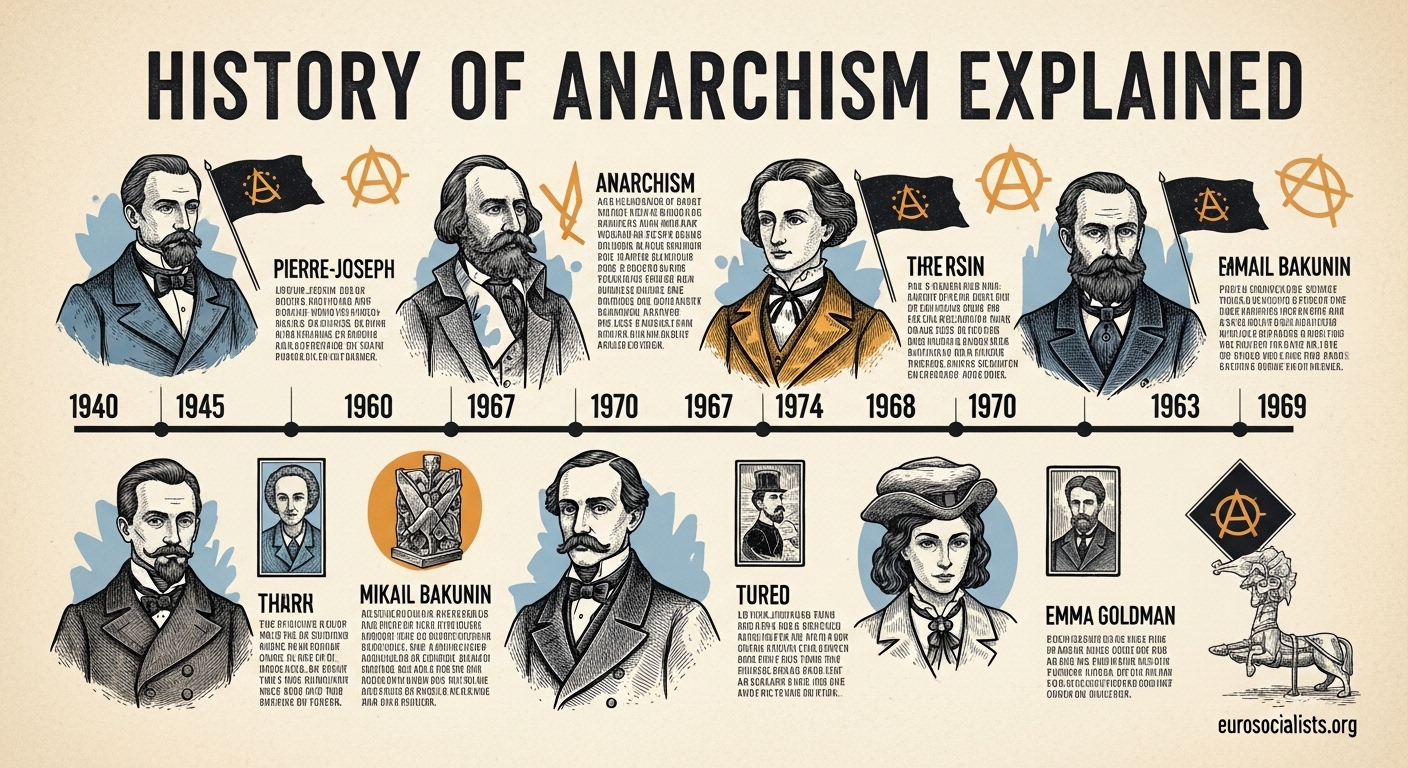
Anarchism is a political philosophy and movement that seeks to abolish all institutions perpetuating authority, coercion, or hierarchy, primarily targeting the state and capitalism. It advocates replacing these structures with stateless societies organized through voluntary cooperation, mutual aid, and free association. The philosophy asserts that human beings can organize their lives peacefully and productively without rulers or centralized authority.
I have spent years studying the development of anarchist thought from its philosophical roots to its modern manifestations. The history of anarchism reveals a rich tradition of political theory and social experimentation that continues to influence movements worldwide in 2026.
This guide traces anarchism from its earliest philosophical precursors through its formal emergence in the 19th century to its contemporary expressions. You will learn about the key thinkers who shaped anarchist theory, the movements that attempted to put these ideas into practice, and the lessons this history offers for those interested in radical social change.
Table of Contents
What Is Anarchism? Definition and Etymology
The word “anarchism” derives from the Greek anarkhia, meaning “without ruler” or “without authority.” This compound joins the prefix an- (without) with arkhos (ruler or authority). The term entered English through Medieval Latin, initially carrying purely negative connotations of disorder and lawlessness.
Anarchists reclaim this etymology positively. They argue that the absence of rulers does not mean the absence of order. Instead, anarchism proposes that order can emerge organically from voluntary cooperation rather than imposed hierarchy.
The core principle uniting all anarchist tendencies is the rejection of hierarchical authority. This includes political authority (the state), economic authority (capitalism and private property), and social authority (patriarchy, racism, religious domination). Anarchists maintain that such hierarchies are unnecessary for human flourishing and actively harmful to individual freedom and collective well-being.
Key Concepts in Anarchist Thought
Voluntary association forms the foundation of anarchist social organization. Anarchists believe that people should form groups, communities, and economic relationships based on free consent rather than coercion. These associations remain legitimate only as long as participants choose to maintain them.
Mutual aid represents another cornerstone concept. Peter Kropotkin’s research demonstrated that cooperation, not competition, drives evolutionary success in both biological and social systems. Anarchists argue that humans naturally help one another when not divided by artificial hierarchies and scarcity.
Federalism in the anarchist context means confederation of autonomous groups. Rather than centralizing power in a national government, anarchists propose that communities and workplaces network together for common purposes while retaining local self-determination.
Precursors to Anarchism: Ancient and Early Modern Thought
While anarchism as a named philosophy began in the 19th century, elements of anarchist thought appear throughout history. Ancient philosophies, religious movements, and Enlightenment thinkers contributed ideas that later anarchists would synthesize into a coherent political theory.
The Stoic philosophers of ancient Greece and Rome developed concepts of natural law that would influence anarchist thought. They argued that true freedom comes from living according to universal reason rather than obeying arbitrary human laws. This distinction between natural and artificial authority resonates throughout anarchist theory.
Early Christian sects practiced voluntary communism and rejected earthly authorities. The Diggers and Levellers during the English Revolution articulated proto-anarchist ideas about common ownership and resistance to arbitrary power. These religious radicals argued that divine law superseded the commands of kings and bishops.
The Enlightenment and Godwin
The Enlightenment’s emphasis on reason and individual liberty created fertile ground for anarchist thought. Jean-Jacques Rousseau’s critique of private property and his concept of popular sovereignty influenced later anarchist thinkers, though Rousseau himself was not an anarchist.
William Godwin published An Enquiry Concerning Political Justice in 1793. This work represents the first systematic exposition of anarchist principles in English. Godwin argued that government corrupts human nature and that voluntary cooperation could replace coercive institutions. He proposed that small autonomous communities could organize economic life without property or law.
Godwin’s ideas remained largely philosophical rather than political. He did not participate in organizing movements, and his individualistic approach differed from the social anarchism that would dominate later. Nevertheless, his work established anarchism as a coherent philosophical position within modern political thought.
Pierre-Joseph Proudhon and the Birth of Anarchism (1840)
Anarchism emerged as a self-conscious political movement on January 5, 1840. On that date, a young French printer named Pierre-Joseph Proudhon published What Is Property? An Inquiry into the Principle of Right and of Government. This work contained the first explicit declaration: “I am an anarchist.”
Proudhon’s famous answer to his titular question was “Property is theft!” This provocative statement did not condemn personal possession of items one uses. Rather, it targeted the capitalist institution of property that allows owners to extract profit from others’ labor without working themselves.
Proudhon distinguished between property (ownership that generates unearned income) and possession (personal use of resources). He argued that workers should control the tools and products of their labor. This distinction would influence anarchist economics for generations.
Mutualism and Federalism
Proudhon developed an economic theory called mutualism. Under mutualism, individuals and groups would exchange goods and services based on the labor invested in producing them. Banking would become a public utility providing interest-free loans. Cooperatives would replace capitalist enterprises.
Politically, Proudhon advocated federalism. He proposed replacing the nation-state with federations of autonomous communes and workers’ associations. These federations would coordinate through contracts rather than laws, with delegates carrying specific mandates from their communities.
Proudhon’s influence extended far beyond his writings. His ideas dominated the early French labor movement and influenced the founding of the First International Workingmen’s Association. Later anarchists would build upon, critique, and diverge from his mutualist foundations, but all acknowledged his role in establishing anarchism as a named political philosophy.
The First International: Anarchism vs. Marxism
The International Workingmen’s Association (IWA), founded in 1864, brought together socialist and working-class organizations from across Europe. Often called the First International, this organization became the battleground for competing visions of revolutionary change. The conflict between anarchists and Marxists would shape the socialist movement for decades.
Proudhon’s followers dominated the French sections of the International initially. They advocated mutualism, federalism, and gradual economic transformation through workers’ cooperatives. The General Council in London, controlled by Karl Marx, promoted different strategies including parliamentary activity and centralized revolutionary government.
The arrival of Mikhail Bakunin in 1869 transformed the anarchist presence in the International. Bakunin organized networks of like-minded revolutionaries and challenged Marx’s dominance. The conflict between these two figures became increasingly personal and ideological.
The Split at The Hague
The 1872 Congress at The Hague marked the definitive rupture. Marx manipulated the proceedings to secure Bakunin’s expulsion from the International. The official organization then relocated to New York, effectively ending its European influence. The expelled sections reorganized as the St. Imier International, committed to federalism and anti-authoritarian socialism.
This split established anarchism as a distinct movement separate from Marxist socialism. Anarchists rejected the concept of a transitional workers’ state, arguing that any government would develop its own interests and perpetuate oppression. They insisted that the revolution must immediately establish free federations rather than new governments.
The conflict revealed fundamental philosophical differences. Marxists believed that capturing state power was necessary to transform society. Anarchists argued that the state itself was the problem and must be abolished, not captured. This debate between authoritarian and libertarian socialism continues to influence radical politics in 2026.
Mikhail Bakunin and Revolutionary Anarchism
Mikhail Bakunin transformed anarchism from Proudhon’s relatively peaceful mutualism into a revolutionary doctrine. Born into the Russian aristocracy in 1814, Bakunin abandoned his privileged position to become professional revolution. His life involved participation in uprisings across Europe, imprisonment, escape, and relentless organizing until his death in 1876.
Bakunin developed what became known as collectivist anarchism. While Proudhon envisioned individual producers exchanging equal values, Bakunin advocated collective ownership of the means of production. He believed that social revolution must abolish both the state and private property simultaneously.
The revolutionary’s critique of religion proved as fierce as his critique of the state. Bakunin argued that religious belief fosters passivity and submission to authority. He saw the church and state as twin pillars of oppression, each supporting the other. This anti-clericalism became standard in anarchist movements.
The Invisible Dictatorship
Bakunin proposed organizing revolutionary forces through what he called an “invisible dictatorship.” This controversial concept meant that dedicated revolutionaries would work within popular movements without revealing their organizational structure. They would guide events through influence rather than official authority.
Many anarchists have criticized this idea as contradictory to anarchist principles. Others defend it as a pragmatic approach to coordinating revolutionary activity without creating formal hierarchy. The debate highlights tensions within anarchism between purity of principle and practical effectiveness.
Bakunin’s organizational work established anarchism as a mass movement. He created the International Alliance of Socialist Democracy and influenced sections of the First International across Southern Europe. His followers would lead major anarchist organizations for decades after his death.
The Paris Commune and Its Impact on Anarchist Thought
The Paris Commune of 1871 lasted only 72 days but profoundly influenced anarchist theory and practice. When Parisian workers and National Guardsmen established an autonomous revolutionary government, anarchists across Europe watched closely. The Commune’s achievements and failures shaped anarchist strategy for generations.
Anarchists participated actively in the Commune, though they remained a minority within the predominantly Blanquist and Proudhonian leadership. The decentralized nature of the Commune’s organization, with power dispersed among neighborhood assemblies, aligned with anarchist principles. Many anarchists considered the Commune a partial realization of their vision.
The bloody suppression of the Commune by French government forces killed approximately 20,000 Parisians. This massacre demonstrated the lengths to which ruling classes would go to maintain power. Anarchists drew the lesson that revolutionaries must be prepared for total struggle and cannot expect mercy from their enemies.
Theoretical Lessons
Bakunin analyzed the Commune as confirming his theories. He argued that the failure to immediately abolish the state apparatus and disperse authority had contributed to the defeat. Had the Communards immediately established free federations of communes rather than maintaining a centralized government, they might have succeeded.
Peter Kropotkin later described the Commune as “the precursor of future revolutions.” He emphasized its attempts at workers’ self-management and the abolition of the wage system. The Commune proved, for anarchists, that ordinary people could manage their own affairs without professional politicians or bureaucrats.
The memory of the Commune became a rallying point for anarchist movements. Anniversaries of its declaration and fall were marked by demonstrations and publications. The martyrs of the Commune, including anarchist participants like Eugene Varlin, became revolutionary heroes whose sacrifice would inspire future movements.
Peter Kropotkin and Communist Anarchism
Prince Peter Kropotkin emerged as the most important anarchist theorist of the late 19th century. Born into the Russian aristocracy in 1842, he abandoned his military career and noble title to become a revolutionary. His scientific training as a geographer informed his approach to anarchism, seeking empirical evidence for his political theories.
Kropotkin’s 1896 work Mutual Aid: A Factor of Evolution revolutionized anarchist theory. Reviewing biological and anthropological evidence, he argued that cooperation rather than competition drives evolutionary success. Species that practice mutual aid survive better than those that fight one another for resources. This scientific foundation countered Social Darwinist arguments against socialism.
Moving beyond Bakunin’s collectivism, Kropotkin advocated communist anarchism. He argued that distribution according to need rather than work performed better aligned with anarchist principles. Under communism, everyone would have access to society’s resources regardless of their productive contribution.
The Conquest of Bread
Kropotkin’s The Conquest of Bread (1892) outlined practical steps for revolutionary transformation. He argued that existing production capacity could feed, clothe, and house everyone if organized rationally rather than for profit. The revolution must immediately expropriate social wealth and distribute it according to need.
The book addressed practical objections to anarchism. How would complex industries function without bosses? How would cities feed themselves? Kropotkin argued that workers already knew how to run their workplaces and that decentralized federations could coordinate economic activity better than central planning.
Kropotkin’s vision influenced anarchist movements worldwide. His emphasis on immediate revolution, expropriation without compensation, and distribution according to need became dominant in the movement. Even anarchists who maintained other economic positions acknowledged his theoretical contributions.
The Classical Period: Late 19th to Early 20th Century
The decades between 1880 and 1920 represent the classical period of anarchism. During these years, anarchist movements grew to their greatest numerical strength and global reach. Anarchists organized unions, published newspapers in dozens of languages, and influenced major political events.
The period also saw the development of “propaganda by the deed” – the theory that dramatic acts of violence against rulers and exploiters would inspire mass uprising. Some anarchists conducted assassinations of heads of state and bombings of symbolic targets. This strategy provoked intense debate within the movement and heavy repression from governments.
The Haymarket affair of 1886 became a defining moment for the anarchist movement. After a bomb exploded during a labor demonstration in Chicago, police arrested eight anarchists. Despite no evidence connecting them to the bombing, four were executed. The Haymarket martyrs became symbols of labor oppression and anarchist resistance.
Global Expansion
Anarchism spread globally during this period. Italian and Spanish anarchists built mass movements. Jewish anarchists organized in Eastern Europe and among immigrants to the Americas. Japanese and Chinese radicals adapted anarchist ideas to Asian contexts. Anarchism became the first truly international revolutionary movement.
In France, the movement grew through the Bourses du Travail (labor exchanges) and revolutionary unions. In Argentina and Uruguay, anarchists organized among immigrant workers and established some of the strongest anarcho-syndicalist movements outside Europe. The United States saw anarchist participation in the Industrial Workers of the World and vibrant immigrant communities.
The classical period established anarchism’s reputation as a serious political force. Even critics acknowledged that anarchists had developed coherent theories and effective organizations. The movement’s peak influence came not through individual acts of violence but through mass participation in labor struggles and social transformation.
Anarcho-Syndicalism and the Labor Movement
Anarcho-syndicalism emerged as the dominant organizational form of anarchism during the early 20th century. This strategy focused on building revolutionary labor unions that would both improve workers’ conditions immediately and prepare for social transformation. The union became the vehicle for both reform and revolution.
The French General Confederation of Labor (CGT) provided the model for anarcho-syndicalist organizing. Though never exclusively anarchist, the CGT practiced direct action, rejected political parties, and advocated the general strike as the means of revolutionary transformation. French syndicalists developed theories of industrial democracy and workers’ self-management.
The Spanish National Confederation of Labor (CNT), founded in 1910, became the world’s largest anarcho-syndicalist organization. At its height, the CNT claimed over a million members. It organized workers across industries, established schools and cultural centers, and prepared for revolutionary transformation of Spanish society.
The General Strike
Anarcho-syndicalists viewed the general strike as the primary revolutionary weapon. When workers across all industries stopped work simultaneously, the capitalist economy would collapse. The union organization built for everyday struggles would coordinate the new society. This approach offered a path to revolution without political parties or military insurrection.
The theory of industrial democracy proposed that workers could manage production through their unions. Each workplace would elect recallable delegates to coordinate with other workplaces. These federations would replace both capitalist management and state bureaucracy. Anarcho-syndicalists argued that such structures could run complex modern economies.
Syndicalist movements achieved significant gains for workers while building revolutionary capacity. They won shorter hours, higher wages, and improved conditions through direct action. They also developed the organizational structures and practical skills that would prove crucial when revolutionary opportunities emerged.
Anarchism and the Russian Revolutions
The Russian Revolutions of 1905 and 1917 created unprecedented opportunities for anarchist activity. In a country with a weak liberal tradition and strong revolutionary movement, anarchist ideas found fertile ground. Russian anarchists participated actively in both revolutionary upheavals, though they ultimately faced defeat at the hands of the Bolsheviks.
The 1905 Revolution saw anarchists organizing in St. Petersburg, Moscow, and the provinces. They participated in the soviets (workers’ councils) and promoted expropriation of capitalist property. Though the revolution failed, it established organizational networks that would re-emerge in 1917.
The Ukrainian revolutionary Nestor Makhno created the most significant anarchist military force during the Civil War that followed 1917. The Makhnovist movement established libertarian communism across much of Ukraine, organizing peasant communes and workers’ councils. Makhno’s Revolutionary Insurgent Army fought against both White reaction and Red centralization.
Suppression by the Bolsheviks
The Bolshevik seizure of power in October 1917 initially created an uneasy alliance with anarchists. Many anarchists supported the Bolsheviks as fellow revolutionaries against counter-revolution. This support faded as the new government consolidated power and suppressed independent working-class organization.
The Bolsheviks systematically dismantled the soviets, factory committees, and other organs of workers’ self-management that had emerged during the revolution. They imprisoned anarchist militants and closed anarchist publications. The Cheka (secret police) hunted down anarchists who resisted these measures.
The Kronstadt rebellion of 1921 marked the definitive break. Sailors at the Kronstadt naval base, many formerly anarchist or anarchist-influenced, rebelled against Bolshevik dictatorship. They demanded soviet democracy without Communist Party control. The Bolshevik suppression of this revolt, led by Trotsky, demonstrated that the new regime would tolerate no opposition from the left.
The Spanish Civil War: Anarchism in Practice
The Spanish Civil War (1936-1939) provided anarchism’s greatest opportunity to implement its theories at scale. When a military coup attempted to overthrow the Republican government in July 1936, anarcho-syndicalist organizations mobilized to defeat the rebellion. In the process, they launched a social revolution that transformed much of Spain.
The CNT-FAI (Iberian Anarchist Federation) organized militias that held front lines while the government hesitated. Behind the lines, workers and peasants expropriated factories and land, establishing collectives run through assemblies and elected committees. For a brief period, anarchism moved from theory to practice across significant territory.
Barcelona became the revolution’s showcase. Workers’ committees ran factories, public services, and distribution networks. Streetcars operated without bosses. Restaurants became communal dining halls. The transformation was rapid and largely peaceful, demonstrating anarchist claims about ordinary people’s capacity for self-organization.
The Rural Collectives
In the countryside, peasants formed agricultural collectives that pooled land and resources. The village assembly made decisions, with elected committees handling daily coordination. Some collectives abolished money entirely; others used labor vouchers or maintained limited internal currency. Thousands of villages participated, affecting millions of people.
These collectives demonstrated impressive economic achievements despite wartime conditions. Agricultural production increased in many areas. Schools, clinics, and cultural centers multiplied. Traditional gender roles began to break down as women participated in collective work and militias.
The revolution’s defeat came not from internal failure but from external military pressure and political betrayal. The Communist-dominated Republican government, with Soviet backing, suppressed the collectives and murdered anarchist leaders. Francisco Franco’s fascist forces eventually conquered the remaining Republican territory. The anarchist movement in Spain never recovered from this defeat.
Anarchism After World War II
World War II devastated the European anarchist movement. Many militants died fighting fascism in Spain, France, and elsewhere. Those who survived faced new challenges: fascist dictatorships in Germany, Italy, and Spain; Soviet domination of Eastern Europe; and the apparent triumph of social democracy in the West.
The Spanish CNT continued underground during Franco’s dictatorship, suffering severe repression. Exile organizations maintained anarchist publications and networks, but the mass base had been destroyed. The dream of libertarian revolution seemed increasingly distant.
In France and Italy, anarchist movements survived but remained marginal. The postwar economic boom and welfare state undermined the radical labor movement. Anarchists focused on maintaining subcultural spaces, publishing, and preparing for future opportunities rather than immediate revolutionary organizing.
The New Left and Anarchist Rebirth
The 1960s New Left provided anarchism’s first significant audience in decades. Students and young workers became interested in libertarian alternatives to both capitalism and Soviet communism. Situationists in France, Provos in the Netherlands, and Yippies in the United States drew on anarchist ideas without necessarily identifying as anarchists.
Murray Bookchin developed social ecology, integrating anarchism with environmental concerns. His concept of libertarian municipalism proposed building anarchist institutions through local democracy and confederation. Bookchin influenced both ecological movements and later Kurdish politics through his connection with Abdullah Ocalan.
By the 1970s, explicit anarchist movements were growing again in Europe and North America. Punk rock culture incorporated anarchist imagery and ideas, bringing them to new generations. Anarchist bookstores, publishing houses, and organizations multiplied. The stage was set for anarchism’s contemporary resurgence.
Contemporary Anarchism: From Anti-Globalization to Today
The anti-globalization movement that emerged in the late 1990s marked anarchism’s return to mass politics. Protests against the World Trade Organization, G8 summits, and international financial institutions involved thousands of anarchists. The 1999 Seattle WTO protests demonstrated anarchist organizing capacity and tactical innovation to a global audience.
Anarchist ideas influenced the movement’s structure and tactics. Networks rather than centralized organizations coordinated activities. Direct action replaced lobbying. Consensus decision-making in affinity groups contrasted with top-down union or party structures. These methods, while not exclusively anarchist, reflected anarchist principles.
The Occupy movement of 2011 further demonstrated anarchist influence. General assemblies using modified consensus, horizontal organizing structures, and the critique of corporate power all echoed anarchist themes. While most participants did not identify as anarchists, the movement’s methods and analysis drew heavily from anarchist theory and practice.
Modern Movements and Challenges
Contemporary anarchism takes diverse forms. Anarcho-primitivists critique civilization itself, advocating return to hunter-gatherer lifeways. Platformists emphasize tactical and theoretical unity in anarchist organizations. Insurrectionary anarchists focus on immediate attack against capitalist infrastructure. These tendencies debate strategy while sharing core opposition to hierarchy.
The Kurdish liberation movement in Rojava (northern Syria) has drawn international anarchist attention. Drawing on Bookchin’s ideas, the Kurds have established a system of democratic confederalism with women’s equality and ecological concerns at its center. Though not purely anarchist, this experiment offers a contemporary example of libertarian socialist organization.
Anarchists today organize around various issues: housing justice, immigrant solidarity, environmental defense, prison abolition, and opposition to fascism. Mutual aid networks provide direct support to communities while building anarchist relationships. The movement remains small compared to its classical period but maintains active presence across the globe in 2026.
Frequently Asked Questions
How did anarchism begin?
Anarchism began formally in 1840 when Pierre-Joseph Proudhon published ‘What Is Property?’ and declared himself an anarchist. However, anarchist ideas developed from Enlightenment thought, particularly the works of William Godwin in the 1790s. The movement grew through the labor organizing of the First International in the 1860s and 1870s, splitting from Marxist socialism over questions of state power and revolutionary strategy.
What is the main idea behind anarchism?
The main idea behind anarchism is that human beings can organize their social, economic, and political lives through voluntary cooperation without hierarchical authority. Anarchists oppose the state, capitalism, and all forms of domination, proposing instead federations of autonomous communities and workers’ associations coordinated through mutual aid and free agreement.
Who was the first anarchist in history?
Pierre-Joseph Proudhon was the first person to explicitly declare himself an anarchist in 1840. While earlier thinkers like William Godwin developed anarchist ideas in the 1790s, they did not use that label. Proudhon’s book ‘What Is Property?’ established anarchism as a named political philosophy and began the movement that continues today.
What is the difference between anarchism and Marxism?
The fundamental difference concerns the state. Marxists believe workers must capture state power and use it to transform society. Anarchists argue that the state itself is the problem and must be abolished, not captured. Marxists support a transitional workers’ government; anarchists advocate immediate establishment of free federations. This disagreement led to the historic split in the First International between Marx and Bakunin.
Has anarchism ever been successful?
Anarchism has achieved significant but temporary successes. The Paris Commune of 1871 demonstrated elements of anarchist organization. The Makhnovist movement in Ukraine (1918-1921) established libertarian communism across significant territory. Most notably, Spanish anarchists during the Civil War (1936-1939) collectivized factories and land, showing anarchism could work at scale. However, all these experiments were defeated by military force.
Is anarchism the same as chaos?
No, anarchism is not chaos. The common misconception conflates ‘anarchy’ (meaning without rulers) with ‘anarchy’ (meaning disorder). Anarchists advocate organized societies based on voluntary cooperation, mutual aid, and federal structures. They propose replacing government coercion with self-management and free association. Anarchist theory emphasizes order emerging organically from human cooperation rather than imposed from above.
Conclusion
The History of Anarchism Explained reveals a political philosophy that has persisted and evolved for nearly two centuries. From Proudhon’s mutualism through Bakunin’s revolutionary anarchism to Kropotkin’s communist vision, anarchist thinkers developed coherent alternatives to both capitalism and state socialism. The movement’s history demonstrates both the possibility and the difficulty of building stateless societies based on voluntary cooperation.
Anarchism’s trajectory shows recurring patterns: periods of mass organization followed by severe repression, theoretical innovation responding to practical challenges, and the tension between purity of principle and practical effectiveness. The Spanish Revolution came closest to realizing anarchist ideals at scale, and its defeat by fascism and Communist betrayal shaped anarchist strategy for generations.
Understanding anarchist history matters today because the fundamental questions anarchists posed remain relevant. How can ordinary people manage their own affairs? What forms of organization can replace both markets and states? How might human beings cooperate without coercion? Whether or not one accepts anarchist answers, grappling with these questions enriches political imagination and informs movements for social transformation in 2026 and beyond.