
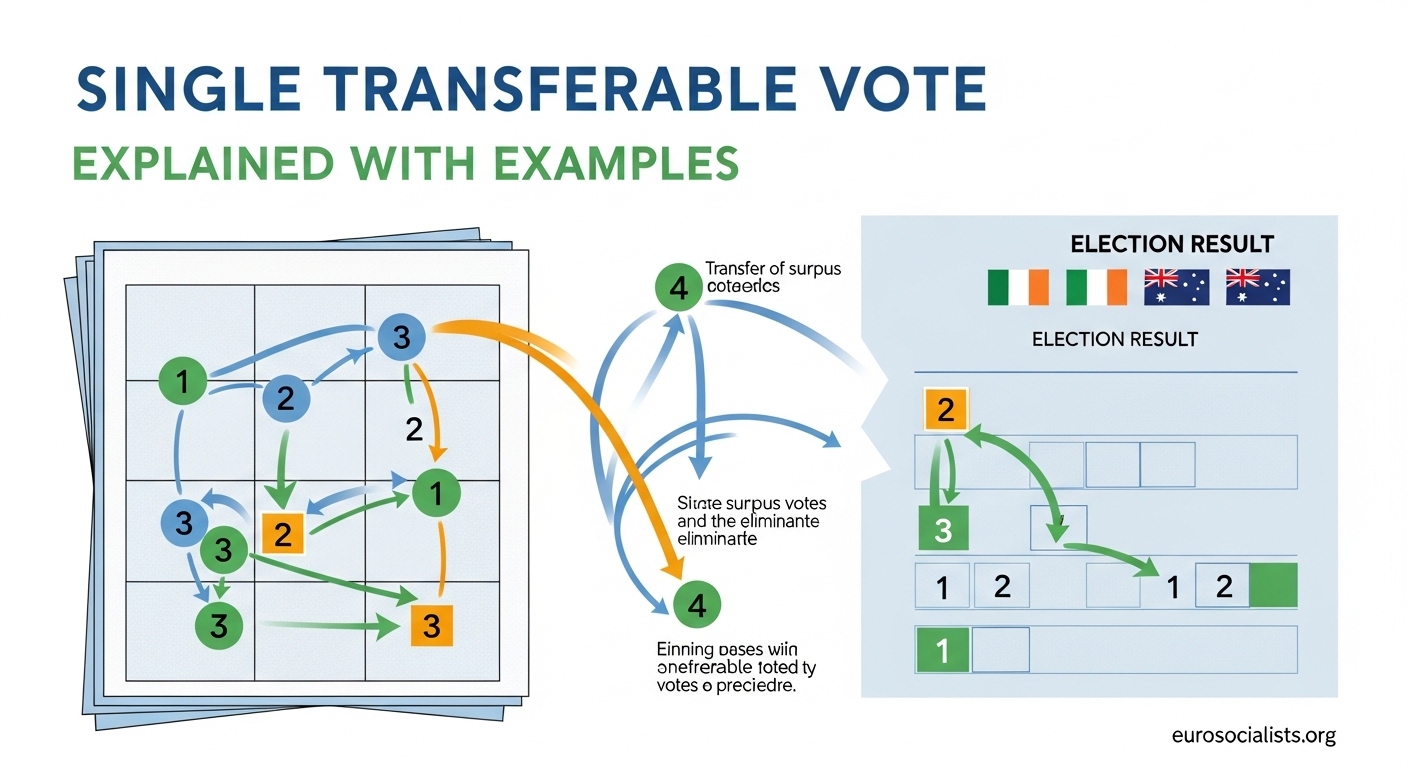
Understanding voting systems is essential for anyone interested in democracy and fair representation. The Single Transferable Vote stands out as one of the most effective methods for ensuring that election results truly reflect the will of the people. In this comprehensive guide, we will walk you through exactly how Single Transferable Vote Explained With Examples works in practice. You will learn the mechanics of ranking candidates, how votes get counted and transferred, and why this system produces more proportional results than traditional methods.
I have researched electoral systems across multiple countries and spoken with voters who use STV regularly. The insights in this article come from real-world applications in Ireland, Malta, Scotland, and Australia. By the end, you will understand not just the theory, but the practical reality of how Single Transferable Vote Explained With Examples can transform democratic participation.
Table of Contents
What Is Single Transferable Vote (STV)?
The Single Transferable Vote is a proportional representation voting system where voters rank candidates in order of preference on their ballot paper. Instead of marking one candidate with an X, voters number candidates 1, 2, 3, and so on until they have no further preferences.
This system operates in multi-member constituencies, meaning each electoral district elects multiple representatives rather than just one. The number of seats per constituency typically ranges from three to seven, though some jurisdictions use different configurations. The key principle is that seats are allocated proportionally based on the share of votes each candidate or party receives.
What makes STV unique is the transfer of votes. When a candidate receives more votes than needed to win a seat, their surplus votes get transferred to other candidates based on voter preferences. Similarly, when a candidate is eliminated, their votes transfer to the next preferred candidate. This process continues until all seats are filled. The result is a highly proportional outcome where nearly every vote counts toward electing someone.
Key Characteristics of STV
Proportional Representation: STV ensures that the makeup of elected representatives closely matches the preferences of voters. A party receiving 30% of first preferences will typically win approximately 30% of the seats.
Ranked Choice Voting: Voters express their preferences by ranking candidates. They can support their favorite candidate while still having a say if that candidate gets eliminated or wins with surplus votes.
Multi-Member Constituencies: Each district elects multiple representatives, which enables proportional results and gives voters more choice in who represents them.
No Wasted Votes: Even if your first choice gets eliminated or wins with surplus votes, your preferences still count toward electing representatives you support.
How Single Transferable Vote Voting Works
The voting process under STV is straightforward for voters, even though the counting gets complex. On election day, voters receive a ballot paper listing all candidates in their constituency. Instead of placing an X next to one candidate, they number candidates in order of preference.
A voter marks 1 next to their first choice candidate, 2 next to their second choice, and continues numbering until they either rank all candidates or choose to stop. Voters can rank as many or as few candidates as they wish. Some voters rank only their top choice, while others rank every candidate on the ballot.
The ballot paper typically includes clear instructions explaining the numbering system. Election officials in countries using STV report that voters adapt quickly to this method. Studies from Ireland show that over 95% of ballots are valid, indicating the system is not difficult for voters to understand.
Step-by-Step Voting Process
Step 1: Receive your ballot paper at the polling station.
Step 2: Review the list of candidates for your constituency.
Step 3: Write 1 next to your first choice candidate.
Step 4: Write 2 next to your second choice, 3 next to your third choice, and continue as desired.
Step 5: Place your completed ballot in the ballot box.
The key advantage is that voters can support their preferred candidate without worrying about strategic voting. Even if that candidate has little chance of winning, the vote will transfer to the voter’s next preference rather than being wasted.
How Votes Are Counted: The Quota System
The counting process in STV revolves around a quota, which is the minimum number of votes a candidate needs to be elected. Once a candidate reaches this quota, they are declared elected. Any votes they receive beyond the quota become surplus votes available for transfer.
The most common quota used in STV elections is the Droop quota. This formula calculates the threshold needed to win while ensuring no more candidates can reach the quota than there are seats available.
The Droop Quota Formula
The Droop quota is calculated using this formula:
Quota = (Valid votes cast ÷ (Seats + 1)) + 1
For example, if 10,000 valid votes are cast in a constituency electing 3 members, the quota would be:
(10,000 ÷ 4) + 1 = 2,501 votes
A candidate needs 2,501 votes to secure election. Once they reach this threshold, they are declared elected, and their surplus votes become available for redistribution.
The Hare Quota
Some jurisdictions use the Hare quota instead, calculated as:
Quota = Valid votes cast ÷ Seats
Using the same example of 10,000 votes and 3 seats:
10,000 ÷ 3 = 3,333 votes
The Hare quota is higher than the Droop quota, meaning candidates need more votes to be elected. The Droop quota is more commonly used because it prevents situations where more candidates could theoretically reach the quota than there are seats available.
First Preference Count
Counting begins by tallying all first preference votes. Each ballot is sorted according to the candidate marked with 1. These totals are compared against the quota. Any candidate reaching the quota is immediately elected.
If all seats are filled at this stage, the count ends. However, in most STV elections, some candidates will have reached the quota while others have not, and some seats remain to be filled. This is where the transfer process begins.
How Votes Are Transferred in STV
Vote transfer is the mechanism that makes STV work. There are two scenarios where votes get transferred: when a candidate has surplus votes after being elected, and when a candidate is eliminated from the count.
Surplus Vote Transfer
When a candidate receives more votes than the quota, their surplus votes are transferred to other candidates. The question is which votes to transfer and at what value.
Most STV systems use a fractional transfer method. If a candidate receives 3,000 votes when the quota is 2,500, they have 500 surplus votes. The transfer value is calculated as:
Transfer value = Surplus ÷ Total votes received
In this case: 500 ÷ 3,000 = 0.166
Every ballot for the elected candidate is then examined to determine the voter’s next preference. Each next preference vote is multiplied by the transfer value. So if 1,500 voters marked Candidate A as first choice and Candidate B as second choice, Candidate B would receive 1,500 × 0.166 = 249 votes from this transfer.
Elimination and Vote Transfer
If no candidate reaches the quota, or if surplus transfers fail to fill remaining seats, the candidate with the fewest votes is eliminated. All of their votes are then transferred to the next preferred candidate on each ballot at full value.
This process continues. After each transfer or elimination, the totals are rechecked against the quota. More candidates may be elected, creating new surplus votes to transfer, or the lowest candidate may be eliminated. The process repeats until all seats are filled.
Gregory Method
The Gregory method is the most common approach for calculating surplus transfers. It examines all ballots of the elected candidate to determine next preferences, then applies the fractional transfer value. This method treats all ballots equally rather than selecting a random sample for transfer.
Some jurisdictions use variations like the Weighted Inclusive Gregory method, which accounts for votes that have already been transferred from other candidates. These technical variations affect how fractional votes are calculated but follow the same basic principle of proportional transfer.
Step-by-Step Example: STV in Action
Let us walk through a concrete example to see exactly how Single Transferable Vote Explained With Examples works in practice. Imagine a constituency electing 2 representatives, with 4 candidates running: Alice, Bob, Carol, and David. There are 1,000 voters.
Step 1: Calculate the quota
Using the Droop quota: (1,000 ÷ (2 + 1)) + 1 = 334 votes needed to win.
Step 2: First preference count
After counting first preferences:
Alice: 400 votes
Bob: 280 votes
Carol: 220 votes
David: 100 votes
Step 3: Elect Alice and transfer surplus
Alice has 400 votes, exceeding the 334 quota by 66 votes. She is elected, and her 66 surplus votes are transferred.
The transfer value is 66 ÷ 400 = 0.165
Examining Alice’s ballots, 250 voters chose Bob as their second preference, 100 chose Carol, and 50 chose David. The transfers are:
Bob receives: 250 × 0.165 = 41 votes
Carol receives: 100 × 0.165 = 17 votes
David receives: 50 × 0.165 = 8 votes
New totals:
Alice: 334 (elected)
Bob: 280 + 41 = 321 votes
Carol: 220 + 17 = 237 votes
David: 100 + 8 = 108 votes
Step 4: Eliminate David
No other candidate has reached the quota. David has the fewest votes and is eliminated. His 108 votes transfer to voters’ next preferences.
Of David’s votes: 70 go to Bob, 30 go to Carol, and 8 have no further preferences and are exhausted.
New totals:
Alice: 334 (elected)
Bob: 321 + 70 = 391 votes (exceeds quota, elected)
Carol: 237 + 30 = 267 votes
Step 5: Result
Both seats are now filled. Alice and Bob are elected. Carol is not elected despite receiving substantial support, which illustrates how STV still produces proportional results based on vote distribution.
This example demonstrates the core mechanics of STV: quota calculation, surplus distribution, and elimination with preference transfer. In real elections with more candidates and seats, the process involves multiple rounds but follows the same principles.
Where Single Transferable Vote Is Used
STV is used in several countries and regions around the world, primarily for national and local elections. The system has proven its effectiveness across different political cultures and electoral contexts.
Ireland
Ireland has used STV for parliamentary elections since independence in 1922. All members of the Dáil Éireann (the lower house of parliament) are elected using STV in multi-member constituencies. Irish voters have decades of experience with the system, and it contributes to the country’s tradition of independent candidates and coalition governments.
Malta
Malta also uses STV for its parliamentary elections. The system has operated there since 1921. Malta’s political system is dominated by two major parties, but STV still ensures proportionality and gives voters significant choice within party lists.
Scotland
Scotland adopted STV for local government elections in 2007. All 32 Scottish councils use STV to elect their members. The system replaced First Past the Post and has increased the diversity of elected representatives while maintaining local accountability.
Australia
Australia uses STV for its Senate elections. The system there is known as the Australian Senate model and includes both above-the-line and below-the-line voting options. Some Australian states, including Tasmania, also use STV for their lower house elections.
Northern Ireland
Northern Ireland uses STV for local elections, Assembly elections, and European Parliament elections. The system was introduced to ensure fair representation for both communities in the divided society.
Other Jurisdictions
New Zealand uses STV for some local body elections, including mayoral races in several cities. Various organizations, universities, and professional bodies use STV for internal elections. The system is also used by the Academy Awards for certain categories.
Single Transferable Vote vs First Past the Post
Understanding the differences between STV and First Past the Post helps clarify why electoral reform advocates often prefer STV. The contrast is stark in terms of voter choice, proportionality, and representation.
Key Differences
Wasted Votes: Under First Past the Post, votes for losing candidates are wasted. Under STV, most votes contribute to electing representatives through the transfer system.
Proportionality: First Past the Post often produces highly disproportionate results where a party winning 40% of votes might secure 60% of seats. STV produces results closely proportional to vote shares.
Voter Choice: First Past the Post limits voters to one choice. STV allows voters to rank candidates, expressing preferences for multiple candidates and parties.
Candidate Competition: Under First Past the Post, parties typically field only one candidate per constituency. STV encourages parties to field multiple candidates, who then compete for preferences from the same party’s supporters.
Representation: First Past the Post creates many safe seats where one party always wins. STV makes most constituencies competitive while still ensuring local representation.
Impact on Representation
The practical impact of these differences is significant. Countries using First Past the Post, like the United Kingdom and United States, often see large disparities between vote share and seat share. Parties can win majority control with minority support.
Countries using STV, like Ireland and Malta, see much closer alignment between voter preferences and parliamentary representation. Coalition governments are more common, and independent candidates have better chances of election.
Advantages and Disadvantages of STV
No voting system is perfect, and STV has both strengths and weaknesses. Understanding these helps evaluate whether STV suits a particular context.
Advantages of STV
Highly Proportional Results: STV produces some of the most proportional outcomes of any voting system. The composition of elected bodies closely reflects voter preferences.
Minimal Wasted Votes: Nearly every vote counts toward electing someone. Voters can support their preferred candidate knowing their vote will transfer if needed.
Greater Voter Choice: Ranking candidates gives voters more expression than marking a single X. Voters can support candidates from different parties or prioritize independents.
Reduced Tactical Voting: Voters can honestly rank their preferences rather than trying to predict who is likely to win.
Strong Local Representation: Despite being proportional, STV maintains constituency links. Voters have multiple representatives they can approach.
Encourages Coalition Building: The system naturally produces results requiring parties to work together, which can lead to more consensus-based politics.
Disadvantages of STV
Complexity: The counting process is complex and difficult for many voters to fully understand. While voting is simple, the mechanics of surplus transfer and elimination can seem opaque.
Time-Consuming Counts: STV counts take longer than simple plurality systems. Results may not be known for days after voting ends.
Large Constituencies: Multi-member constituencies can become large geographically, potentially weakening the local link between representatives and communities.
Party Control Challenges: Because voters choose between candidates from the same party, party discipline can be harder to maintain.
Counting Errors: The complexity increases the risk of counting errors, requiring careful quality control.
From my research, the complexity criticism is the most commonly raised concern. However, voters in Ireland and Malta consistently report satisfaction with the system once they become familiar with it. The benefits of proportionality and choice typically outweigh the learning curve.
FAQs
What is the Single Transferable Vote system and how does it work?
The Single Transferable Vote is a proportional representation voting system where voters rank candidates in order of preference. Candidates need to reach a quota to be elected. Surplus votes from elected candidates and votes from eliminated candidates transfer to other candidates based on voter preferences until all seats are filled.
What countries use the Single Transferable Vote system?
Ireland uses STV for parliamentary elections, Malta for national elections, Scotland for local government elections, and Australia for Senate elections. Northern Ireland uses STV for Assembly and local elections. New Zealand also uses it for some local body elections.
What are the advantages and disadvantages of STV?
Advantages include proportional results, minimal wasted votes, greater voter choice, and reduced tactical voting. Disadvantages include complexity of the counting process, longer counting times, and potentially large constituencies. Most voters adapt quickly to the ranking system despite initial complexity concerns.
How is the quota calculated in STV elections?
The most common quota is the Droop quota, calculated as: (Valid votes cast ÷ (Seats + 1)) + 1. This ensures candidates need enough votes to be elected while preventing more candidates from reaching the quota than there are seats available. Some jurisdictions use the Hare quota instead.
How are votes transferred in STV?
Votes transfer in two scenarios. When a candidate exceeds the quota, surplus votes transfer fractionally to next preferences. When a candidate is eliminated, their votes transfer at full value to the next preferred candidate. This continues until all seats are filled.
What is the difference between STV and First Past the Post?
First Past the Post awards seats to candidates with the most votes, often creating disproportionate results and wasted votes. STV uses ranked ballots and vote transfers to achieve proportional representation. STV gives voters more choice and ensures nearly every vote contributes to electing representatives.
What is the Hare method and how is it used in STV?
The Hare method, also called the Hare quota, calculates the quota by dividing valid votes by the number of seats. While simpler than the Droop quota, it is less commonly used because it can theoretically allow more candidates to reach the quota than available seats. Most STV systems now prefer the Droop quota.
Conclusion
The Single Transferable Vote Explained With Examples demonstrates why this system is considered one of the most effective methods for achieving proportional representation. By allowing voters to rank candidates and transferring surplus votes, STV ensures that election results closely reflect voter preferences.
The key benefits of STV include minimal wasted votes, greater voter choice, and highly proportional outcomes. While the counting process is more complex than simpler systems, voters in Ireland, Malta, and Scotland have shown that the ranking ballot is easy to use. The complexity lies in the counting, not the voting.
As democracies grapple with questions of fair representation and voter engagement, STV offers a proven alternative to winner-take-all systems. Whether you are studying electoral systems, considering reform options, or simply curious about how voting works in other countries, understanding Single Transferable Vote Explained With Examples provides valuable insight into how democracy can be organized to represent the full diversity of voter opinion.