
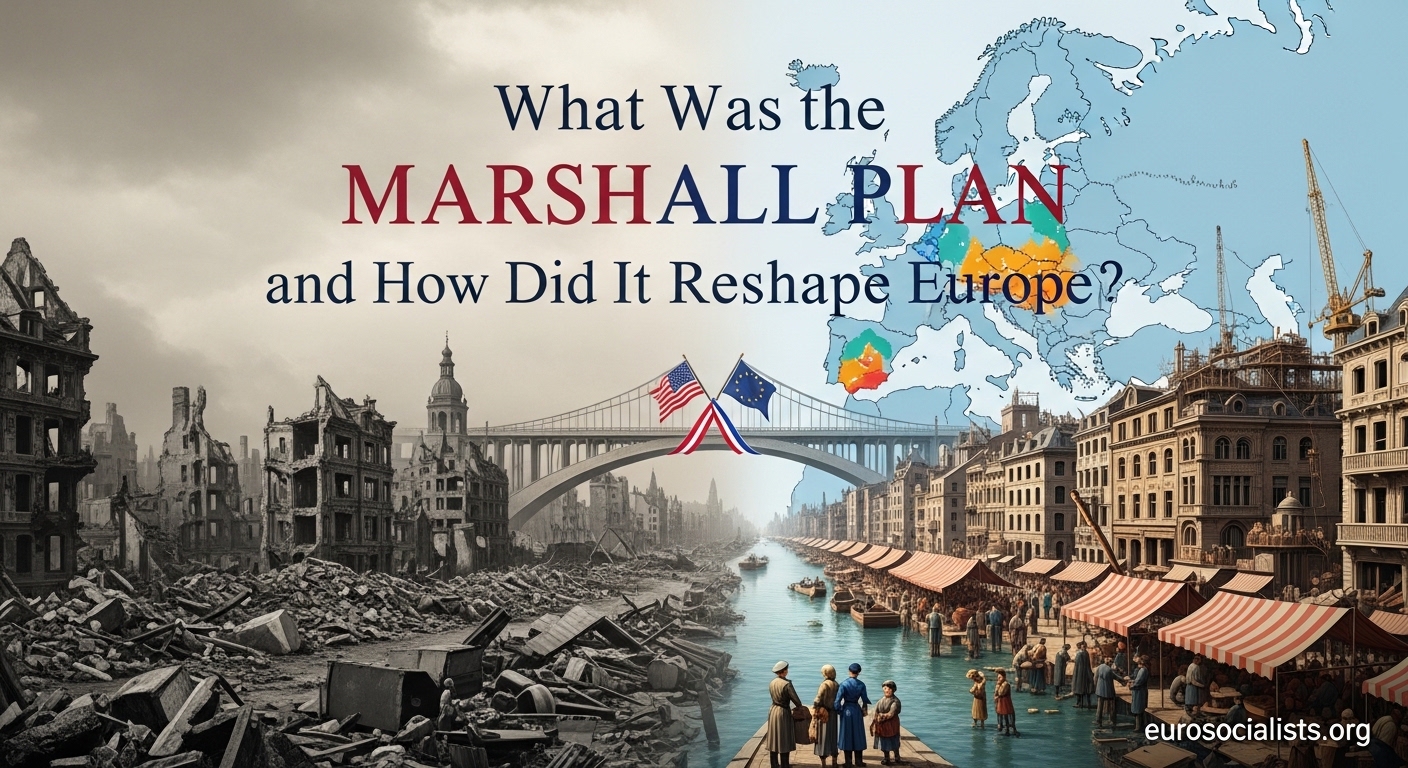
By the spring of 1947, Europe was a continent on the brink. World War II had ended nearly two years prior, yet millions of civilians remained homeless, factories lay in ruins, and economies teetered toward collapse. In this moment of crisis, Secretary of State George Marshall delivered a speech at Harvard University that would transform the postwar world. The Marshall Plan was a massive American initiative that provided over $13 billion in economic aid to rebuild Western European nations between 1948 and 1952. It was formally known as the European Recovery Program (ERP), and it fundamentally reshaped not only the economies of recipient nations but also the geopolitical landscape of the entire Cold War era.
This comprehensive guide explores what the Marshall Plan was, how it worked, and why its effects continue to influence foreign policy discussions today.
Table of Contents
What Was the Marshall Plan and How Did It Reshape Europe?
The Marshall Plan was the single most successful structural adjustment program in history. Launched officially in 1948 after President Harry Truman signed the Economic Recovery Act, the plan channeled approximately $13 billion into sixteen Western European nations over four years. The goal was simple yet ambitious: revive working economies, restore industrial production, and create stability that would prevent the spread of communism.
What made the plan revolutionary was its approach. Rather than simply distributing money, the United States provided funds that recipient nations used to purchase American food, fuel, and machinery. The Organization for European Economic Cooperation (OEEC) coordinated distribution, ensuring participating countries implemented policies to boost production and reduce trade barriers. This combination of aid and structural reform created the foundation for the European economic miracle of the 1950s.
The Devastated Continent: Europe After World War II
When Germany surrendered in May 1945, Europe faced destruction on a scale never before witnessed. Major cities from London to Berlin lay in rubble. Transportation networks had been bombed into uselessness. Agricultural output had plummeted, leading to severe food shortages across the continent. Industrial production in 1947 stood at only 70 percent of prewar levels in Western Europe.
The winter of 1946-1947 proved especially devastating. Harsh weather damaged crops already weakened by wartime neglect. Coal shortages crippled what remained of European industry. In Britain, bread rationing continued until 1948, years after the war ended. In Germany, displaced persons camps overflowed with refugees. The continent faced what historians call the “dollar gap” – a shortage of American currency needed to purchase essential imports.
Beyond the physical destruction loomed a political threat. Communist parties were gaining strength across Western Europe, particularly in France and Italy. The Soviet Union, having absorbed Eastern European nations into its sphere of influence, appeared poised to extend its reach further west. American policymakers feared that economic collapse would create conditions ripe for communist subjugation.
George Marshall’s Harvard Commencement Speech (June 5, 1947)
On June 5, 1947, General George Catlett Marshall stood before 15,000 people in Harvard Yard to deliver the university’s commencement address. What he said that day would reshape history. Marshall, who had served as Army Chief of Staff during World War II and was now Secretary of State, chose not to discuss military matters or celebrate Allied victory. Instead, he issued a call to action.
“Our policy is directed not against any country or doctrine but against hunger, poverty, desperation, and chaos,” Marshall declared. He proposed that the United States assist European nations in developing a coordinated recovery program. The aid would be available to any European nation, including the Soviet Union, provided they committed to economic cooperation.
The speech was brief – just over ten minutes – and initially received limited press coverage in the United States. However, European correspondents recognized its significance immediately. British Foreign Secretary Ernest Bevin called it “one of the greatest speeches in world history” upon hearing the text. Within days, European governments began discussing how to respond.
The Truman Doctrine and Early Foreign Aid
The Marshall Plan did not emerge from a vacuum. It built directly upon the Truman Doctrine, announced by President Harry Truman in March 1947. The Truman Doctrine committed the United States to supporting free peoples resisting subjugation by armed minorities or outside pressures. Congress had already approved $400 million in military and economic aid to Greece and Turkey, nations facing communist insurgencies.
Under Secretary of State Dean Acheson had laid groundwork for the Marshall Plan weeks earlier. In a speech to the Delta Council in Cleveland, Mississippi, on May 8, 1947, Acheson warned that without American assistance, Europe would face economic, social, and political disaster. He described the “dollar deficit” crisis and the threat of communist infiltration. This speech, delivered in Marshall’s home state, helped prepare public opinion for the larger aid program to come.
William Clayton, Under Secretary of State for Economic Affairs, played an often-overlooked but crucial role. After touring Europe in 1947, Clayton returned with disturbing observations about conditions he witnessed. He drafted the initial policy recommendations that became the blueprint for the Marshall Plan, arguing that Europe needed not charity but a comprehensive program of reconstruction assistance.
Soviet Rejection and the Division of Europe
The Soviet Union’s response to Marshall’s proposal would divide Europe for generations. Initially, Stalin showed interest. Soviet Foreign Minister Vyacheslav Molotov attended preliminary meetings in Paris in June 1947. However, Stalin soon recognized that accepting American aid would require economic transparency and cooperation that threatened Soviet control over Eastern Europe.
Molotov withdrew from negotiations on July 2, 1947, labeling the plan an American scheme for economic domination. The Soviet Union then pressured its satellite states to reject participation. Poland and Czechoslovakia, which had initially expressed interest, were forced to decline. This rejection cemented the division of Europe into Western and Soviet spheres that would define the Cold War.
The Soviet Union responded by creating the Molotov Plan, later formalized as the Council for Mutual Economic Assistance (COMECON) in 1949. This established an economic bloc of Soviet-aligned nations. The Iron Curtain, a term popularized by Winston Churchill in 1946, became a physical and economic reality. The Marshall Plan thus accelerated rather than prevented the division of Europe.
Crafting the European Recovery Program
Sixteen Western European nations gathered in Paris from July to September 1947 to develop a coordinated response to Marshall’s offer. The Committee of European Economic Cooperation (CEEC) included Austria, Belgium, Denmark, France, Greece, Iceland, Ireland, Italy, Luxembourg, the Netherlands, Norway, Portugal, Sweden, Switzerland, Turkey, and the United Kingdom. These nations drafted a four-year recovery program requesting American assistance.
The proposal reached Washington in late 1947, sparking intense congressional debate. Critics argued the cost was too high and questioned whether American taxpayers should fund European recovery. Senator Robert Taft of Ohio led Republican opposition, calling the plan a “socialist blueprint.” Midwestern legislators worried about diverting resources from domestic needs.
Advocates mobilized support through the Citizens Committee for the Marshall Plan, a grassroots organization featuring business leaders, labor representatives, and civic groups. Former Secretary of War Henry Stimson and other prominent Republicans crossed party lines to support the legislation. After intense lobbying, Congress passed the Economic Cooperation Act on March 13, 1948, with Truman signing it into law on April 3, 1948.
The legislation created the Economic Cooperation Administration (ECA) to oversee implementation. Paul Hoffman, a former automobile executive, led the ECA, bringing business efficiency to government aid distribution. The ECA established offices in each recipient nation, working closely with local governments to ensure funds reached their intended purposes.
$13 Billion and Four Years: The Scope of American Aid
The Marshall Plan ultimately provided $13.3 billion in economic assistance between 1948 and 1952. Adjusted for inflation, this represents roughly $150 billion in 2026 dollars. The aid flowed through several mechanisms: direct grants, loans, and conditional funding tied to specific purchases.
Great Britain received the largest share at approximately $3.3 billion, followed by France with $2.9 billion, West Germany with $1.9 billion, and Italy with $1.5 billion. Even smaller nations benefited significantly – the Netherlands received over $1 billion, while tiny Iceland received $43 million, representing a substantial per-capita investment.
Recipient nations used these funds primarily to purchase American exports: wheat and other foodstuffs, coal and fuel oil, industrial machinery, and raw materials. The so-called “counterpart funds” – local currency deposits created when American aid purchased goods – supported additional infrastructure projects. In West Germany, counterpart funds built the Autobahn system. In France, they modernized the railway network.
The OEEC coordinated distribution among participating nations, establishing the principle of European economic cooperation that would eventually evolve into the European Union. This institutional framework proved as valuable as the money itself, creating habits of consultation and coordination that outlasted the aid program.
How the Marshall Plan Reshaped European Economies
The results of the Marshall Plan exceeded even optimistic projections. By 1952, industrial production in participating nations had increased 35 percent above prewar levels. Agricultural output recovered to prewar levels by 1950 and continued climbing. The “dollar gap” narrowed as European exports to the United States increased.
West Germany’s transformation proved most dramatic. From the devastation of 1945, the German economy emerged as Europe’s industrial powerhouse. The plan funded coal mine modernization, steel plant reconstruction, and transportation improvements. By 1952, German industrial production exceeded 1938 levels. This economic miracle laid the foundation for the Federal Republic’s integration into Western institutions.
France used Marshall aid to modernize its industrial base, particularly in coal, steel, and transport. The Monnet Plan, France’s national modernization program, received significant American support. Italy channeled funds into southern development projects, beginning to close the economic gap between the industrial north and impoverished south.
Less tangible but equally important were the psychological effects. The plan demonstrated American commitment to European recovery, restoring confidence among populations worn down by war and deprivation. Business investment increased as stability returned. Labor unions accepted wage restraint knowing that economic growth would ultimately benefit workers. This social compact enabled rapid recovery without the inflation that had plagued post-World War I Europe.
The Marshall Plan’s Role in the Cold War
The Marshall Plan represented a pivotal moment in Cold War strategy. By stabilizing Western European economies, it successfully implemented the containment policy that would guide American foreign policy for decades. Communist parties in France and Italy, which had been gaining strength in 1947, saw their support decline as economic conditions improved.
The plan also transformed the United States from wartime ally to permanent European power. American military bases expanded across Western Europe. The North Atlantic Treaty Organization (NATO), established in 1949, formalized the security relationship that economic aid had initiated. The United States had committed itself to European defense and prosperity for the long term.
European integration emerged as an unintended but lasting consequence. The OEEC’s success demonstrated that cooperation across national boundaries could work. This experience directly influenced the creation of the European Coal and Steel Community in 1951, precursor to the European Economic Community and today’s European Union. The Marshall Plan thus helped create the institutional framework for modern Europe.
George Marshall himself received recognition for his vision. In 1953, he was awarded the Nobel Peace Prize, the only American military leader so honored for peacetime service. The citation praised his contribution to the “economic and social rehabilitation of Europe.”
Was the Marshall Plan a Success? Historical Debates
While most historians acknowledge the Marshall Plan’s positive impact, debate continues about its necessity and primary beneficiaries. British economic historian Alan Milward challenged the conventional narrative in his 1984 study “The Reconstruction of Western Europe.” Milward argued that European recovery was already underway by 1947 and would have proceeded without American aid.
Other scholars note that the plan benefited American interests significantly. By requiring recipients to purchase American goods, the program stimulated the U.S. economy and alleviated postwar recession fears. The aid also created lasting markets for American exports and established the dollar as the dominant international currency.
Some critics argue the plan represented American economic imperialism, using aid to penetrate European markets and influence political decisions. The requirement for economic transparency and policy reforms did give American officials significant leverage over recipient nations. However, defenders counter that European governments maintained autonomy and that the conditions promoted sound economic policies rather than American control.
Alternative history enthusiasts on forums like alternatehistory.com have explored what might have happened without the Marshall Plan. Most scenarios suggest slower European recovery, stronger communist parties, and potentially earlier Soviet collapse due to the burden of supporting Eastern European satellites without Western competition. However, these speculations remain just that – informed guesses about a past that never happened.
Frequently Asked Questions About the Marshall Plan
What did the Marshall Plan do for Europe?
What was the Marshall Plan designed to do?
Which country refused Marshall Plan aid?
Was the Marshall Plan a success or failure?
Did the Marshall Plan ever end?
In what two ways did the Marshall Plan benefit European countries?
Why was the Marshall Plan historically significant?
How did the Marshall Plan benefit the United States?
The Enduring Legacy of the Marshall Plan
The Marshall Plan stands as one of the most consequential foreign policy decisions in American history. What began as a commencement speech at Harvard became a four-year commitment that transformed sixteen nations and reshaped the global order. The plan demonstrated that economic assistance, strategically deployed, could achieve political objectives that military force alone could not.
What was the Marshall Plan and how did it reshape Europe? It was an investment in stability that paid dividends for generations. The European Union, NATO, and the broader Western alliance system all trace roots to the cooperation and commitment forged during those critical years from 1948 to 1952. The plan showed that helping others rebuild could serve both humanitarian and strategic purposes simultaneously.
Today, policymakers still invoke the Marshall Plan when proposing large-scale aid programs, from the reconstruction of Afghanistan to development assistance in Africa. While conditions differ dramatically from postwar Europe, the basic insight remains: economic stability creates political stability, and strategic investment in allies serves long-term national interests. George Marshall’s vision, born from the devastation of World War II, continues to shape how nations think about foreign aid and international cooperation in the 2026 century.